Best Deep Conditioning Hair Masks for Damaged & Dry Hair
The deep conditioning hair masks that genuinely repaired my dry, over-processed hair, from a molecular repair treatment to a drugstore favorite. An honest guide.

I went through a phase in my late thirties where I was convinced my hair was simply broken beyond repair. I had been highlighting it for years, adding heat on top of heat, and generally treating my strands like they were invincible. By the time I actually looked at the damage, I had a situation: dry ends that snapped instead of stretched, a texture that felt like straw by the third day after washing, and a general dullness that no amount of finishing product could fix.
What turned it around was not a new shampoo or a protein treatment. It was committing to a consistent deep conditioning routine with the right masks. Not the masks I had been using, where I slapped on a conditioning packet from the drugstore and rinsed it off in two minutes. I mean real deep conditioning, with products formulated for actual repair, applied with real time built in.
I have now tested more masks than I want to admit. The ones on this list are the three that made a lasting difference in my hair's condition, and I can tell you specifically what each one did and why it worked.
What Deep Conditioning Actually Does
Your hair shaft has an outer layer called the cuticle, made up of overlapping scales. When the cuticle is intact, your hair reflects light (shine), resists moisture loss (softness), and lies smooth (frizz control). When the cuticle is damaged, from bleach, heat, or environmental stress, those scales lift and crack. Moisture escapes, protein escapes, and your hair feels dry and rough no matter how much you condition it in the shower.
A regular rinse-out conditioner sits on the surface of the hair and temporarily smooths the cuticle. It works, but the effect is short-lived and superficial. A deep conditioning mask is formulated with larger concentrations of moisturizing and repairing agents, and it needs time, usually ten to thirty minutes, to penetrate beyond the surface and actually address what is happening inside the hair shaft.
The best masks do at least one of three things: they replace lost moisture with humectants and emollients, they temporarily fill in structural gaps in the hair shaft with proteins or bond-building ingredients, or they reduce the inflammation and oxidative stress in the scalp that leads to continued damage. The masks on this list each do something distinct, and that is why I use all three in rotation rather than picking just one.
What I Look For Before Buying a Mask
Bond-building ingredients. If your hair is chemically processed (bleached, colored, permed, or relaxed), you want a mask that addresses bond damage. This is the category that K18 pioneered, using a patented peptide that reconnects broken polypeptide chains. Olaplex also does this with its bis-aminopropyl diglycol dimaleate. This technology does something regular conditioning cannot.
Humectants alongside oils. Good masks balance humectants, ingredients that draw moisture from the air into the hair shaft, with occlusives or emollients that seal that moisture in. Honey, glycerin, and panthenol are humectants. Shea butter, argan oil, and coconut oil are emollients. You need both. A mask that is only humectants can pull moisture out of the hair on dry or low-humidity days.
Proteins at the right level. Protein is genuinely helpful for chemically processed or fine hair, because it temporarily reinforces the weakened hair shaft. Too much, though, and hair becomes stiff and brittle. If your hair already feels hard or breaks easily, you may have protein overload and need a moisture-focused mask rather than a protein-heavy one.
Time on the hair. Any mask needs at least ten minutes to do meaningful work. The overnight or thirty-minute formulas are not just marketing. Penetration takes time, especially for ingredients targeting the cortex rather than just the cuticle surface.
K18 Leave-In Molecular Repair Hair Mask
This is the one that changed my thinking about what a hair mask can do. The K18 Leave-In Molecular Repair Mask uses a patented synthetic peptide called K18PEPTIDE that mimics the structure of human hair's natural polypeptide chains. When you apply it, the peptide diffuses into the hair cortex and reconnects broken chains at the molecular level. It is not just coating the outside. It is actually fixing something structural inside.
The application is unlike any other mask I have used. You apply it to clean, towel-dried hair, leave it for four minutes, and then style as usual. You do not rinse it out. This was hard to accept at first because everything in my conditioning instinct says masks should be rinsed. But rinsing removes the peptide before it can finish binding. You leave it in, and then you let heat from blow drying or natural drying lock the repair in place.
What I noticed after the second use: my hair stopped snapping at the ends when I ran a fine-tooth comb through it. After four or five uses, the texture at my roots felt genuinely different, smoother and less puffy. After about six weeks of twice-weekly use, my hairdresser commented that the mid-lengths looked better than they had in years. She did not know I had been using K18. She just noticed the difference.
The honest trade-off: K18 is not cheap, and it is not a moisturizer. If your hair is dry but not structurally damaged, this is probably more mask than you need. But if you have chemical damage, if your hair has been bleached or heavily colored, this is the most effective thing I have found for actual repair.
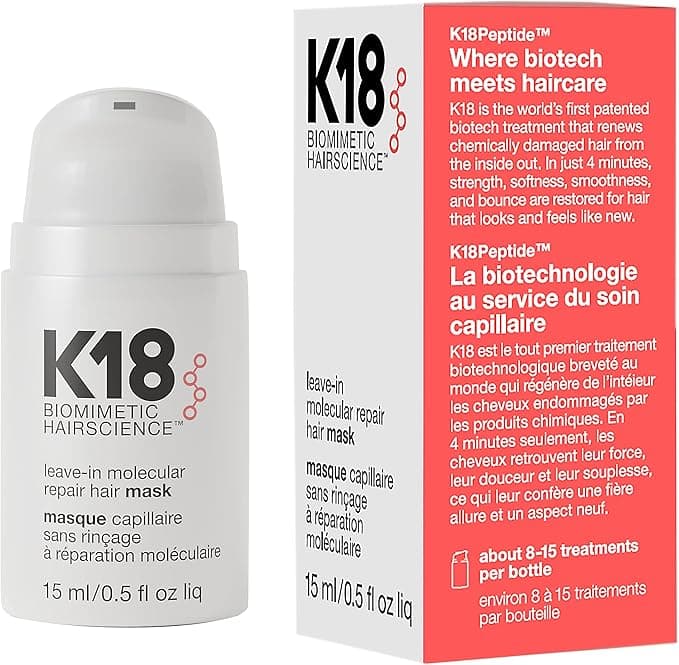
K18 Leave-In Molecular Repair Hair Mask
The molecular repair treatment I trust most for chemically damaged hair. Patented K18PEPTIDE reconnects broken polypeptide chains inside the hair cortex in four minutes. Leave-in formula, does not rinse out. Use after washing twice a week and style as usual. Results are cumulative and structural, not just a surface smoothing effect.
One thing worth knowing: K18 does not replace your conditioner. You still use your regular rinse-out conditioner in the shower, then apply K18 after towel drying. It adds a step but does not eliminate one.
SheaMoisture Manuka Honey & Mafura Oil Intensive Hydration Masque
This is the mask I reach for when my hair is dry more than damaged, when it needs moisture and softness rather than bond repair. The SheaMoisture Manuka Honey masque is one of the most consistently reliable deep conditioners I have found at any price point, let alone at the price it sells for.
Manuka honey is a humectant, which means it draws moisture from the environment into the hair shaft. Mafura oil, which comes from the African mafura tree, is a deeply conditioning oil that strengthens hair and adds elasticity. Certified organic shea butter rounds out the formula as an occlusive, sealing in the moisture the honey draws in. When these three ingredients work together on already-porous, over-processed hair, the result is genuinely soft, manageable, elastic hair that holds moisture for days instead of hours.
I apply this mask to damp hair after shampooing, work it through from mid-lengths to ends, and leave it on for twenty to thirty minutes under a plastic cap. The heat from the cap helps the ingredients penetrate. After rinsing, my hair is noticeably softer even when wet, which is usually the first sign a mask actually did something.
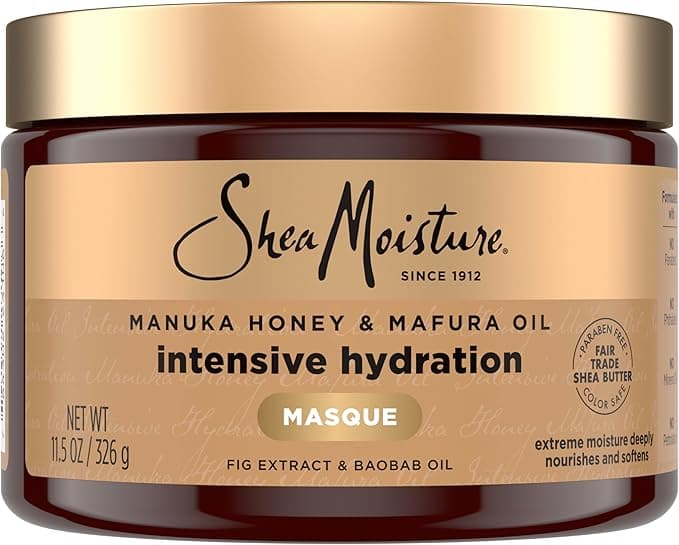
SheaMoisture Manuka Honey & Mafura Oil Intensive Hydration Masque
My moisture-focused mask for dry, thirsty hair. Manuka honey draws in moisture, mafura oil strengthens and adds elasticity, and shea butter locks everything in. Apply to damp hair after shampooing, leave for twenty to thirty minutes under a plastic cap, then rinse. Hair feels genuinely soft and elastic after one use, and the effect builds with consistent use.
The caveat: this mask is thick and rich, which is exactly what dry hair needs. Fine or low-porosity hair may find it too heavy, particularly if applied from roots to ends. I use it only on my mid-lengths and ends and keep it off my scalp entirely. If you have fine hair, start with a smaller amount and see how your hair responds before doing a full application.
amika soulfood Nourishing Mask
The amika soulfood mask is the one I keep in the shower for regular maintenance. It is not a rescue treatment like K18 and it is not as intensely moisturizing as the SheaMoisture, but it is the mask that makes my hair feel good week after week without ever feeling heavy or building up.
The formula uses sea buckthorn and jojoba seed oil as the anchor ingredients. Sea buckthorn is one of the more unusual oils in hair care because it is genuinely rich in omega fatty acids and vitamins C, E, and K, all of which support the scalp and hair follicle health over time. Jojoba is chemically similar to the scalp's natural sebum, which means it absorbs without feeling greasy and conditions without disrupting the scalp's oil balance.
What distinguishes the amika soulfood from other nourishing masks is the texture. It is creamy without being heavy, and it rinses completely clean with no film or residue. On weeks when I have used it instead of a regular conditioner, my hair has the same softness but better manageability and a noticeably better smell.
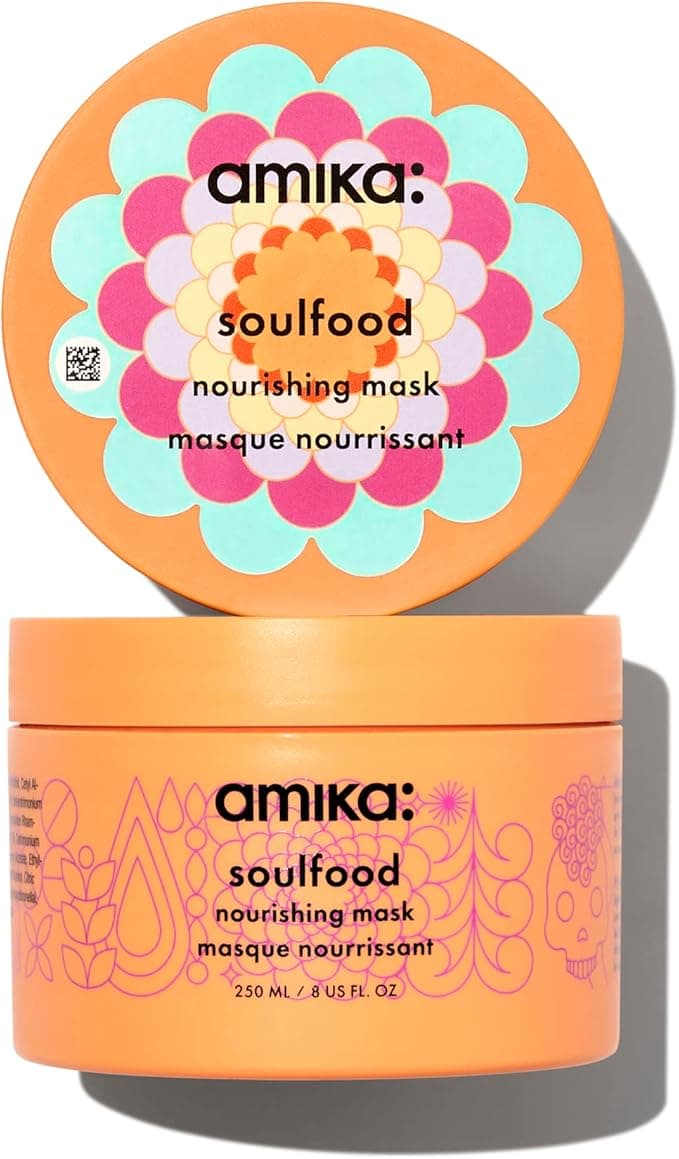
amika soulfood Nourishing Mask
The maintenance mask I use regularly between repair treatments. Sea buckthorn oil and jojoba seed oil nourish the hair and scalp with omega fatty acids and vitamins without leaving residue or weighing strands down. Creamy texture rinses clean. Use weekly as a conditioner upgrade for ongoing softness and health without buildup. Works for all hair types including fine.
The honest limitation: if your hair is severely damaged, the amika soulfood alone will not do the repair work that K18 does. Think of it as maintenance rather than treatment. Once you have done the structural repair, this mask keeps the hair in good condition week to week.
How I Use These Three Together
My current routine uses all three, but in a specific way based on what my hair needs.
On weeks when my hair has been heavily heat-styled or I have done a touch-up on my color, I use K18 twice, on wash day and again mid-week if I wash twice. I apply it after conditioning and let it sit in while I get ready, then blow dry.
About every ten days, I do a twenty-minute SheaMoisture masque session. I wash, apply the masque, put my hair up under a shower cap, and spend the time doing something else. I rinse, then apply K18 as usual.
For regular weekly washing with no special treatment that week, I use the amika soulfood as my conditioner. Apply after shampooing, leave for three to five minutes, rinse.
The other thing that made a real difference running alongside this routine: addressing the things outside of products. I write about the connection between what is hair porosity and how conditioners and masks actually absorb, which helped me understand why some masks were working better for me at different times. Highly porous hair needs different moisture strategies than low-porosity hair, and matching the product to your porosity type makes a real difference in results.
What Did Not Work for Me
For full transparency: I tried two very highly rated masks that simply did not deliver for my hair type. One was marketed specifically for color-treated hair and was full of plant proteins. It made my hair feel temporarily smooth but noticeably harder over time. I eventually realized I had protein overload from using it weekly when my hair needed moisture, not more protein. I scaled back to every three weeks and the hardness went away.
The second was a salon brand mask that cost about twice what the SheaMoisture costs. The ingredient list was genuinely impressive, but the texture was so thick that I could not distribute it evenly through my hair without it taking out half my styling time. The results were not different enough from the SheaMoisture to justify the price or the application difficulty.
The masks on this list made my list not just because they work, but because they are practical to use. Complexity is the enemy of consistency, and consistency is the only thing that actually repairs damaged hair over time.