Best Homeschool Math Manipulatives We Actually Use
The four homeschool math manipulatives in weekly rotation for four boys at different grade levels, with honest notes on what each one is actually for.
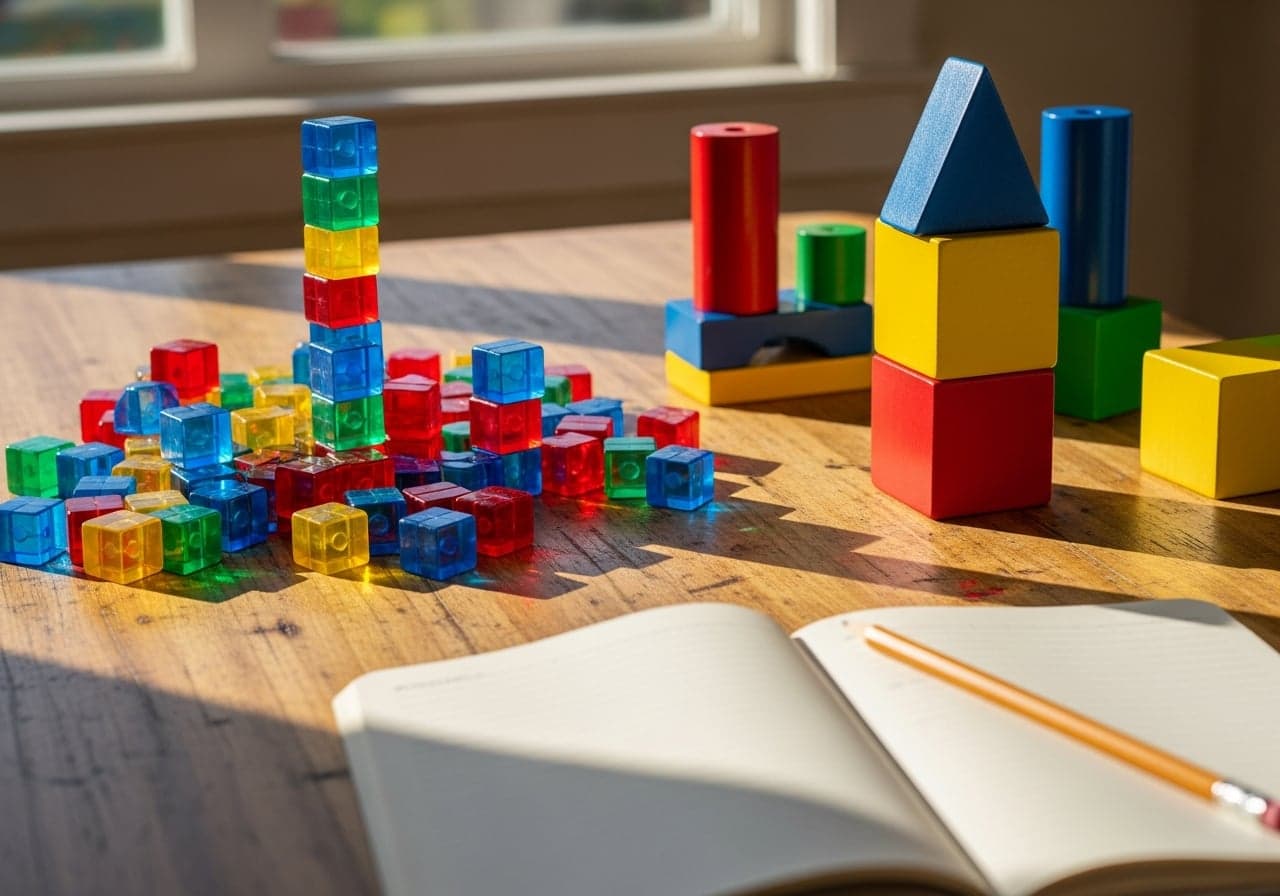
I own a bin of math manipulatives that never gets touched and four that never make it back to the shelf. For years I assumed more pieces meant more learning, so I kept buying sets that looked impressive in the box and then sat under a couch cushion for six months. What actually changed our math time was narrowing down to a small handful of manipulatives that cover the concepts my boys actually get stuck on, at whatever grade each of them happens to be in that year.
That is the real challenge of homeschooling four kids through math at once. My oldest is working through fractions and long division while my youngest is still counting past twenty, and I do not have the bandwidth to run four completely separate manipulative systems. What follows are the four sets that earn their spot in our homeschool room, why each one solves a specific problem, and where I have found the honest limits of each.
What to Look for in Homeschool Math Manipulatives
Before the picks, a few things I wish I had known before spending money on manipulatives that ended up in a drawer.
Pick manipulatives that grow with the kid, not just the grade. Cubes that link together for counting in kindergarten can be repurposed for multiplication arrays years later. A set that only teaches one narrow skill has a much shorter useful life in a homeschool with kids spanning several ages.
Durability actually matters more than it sounds. These get dropped, stepped on, and occasionally used as building blocks for something that has nothing to do with math. Cheap plastic that cracks after a month of real use costs more in the long run than a sturdier set that costs a bit more up front.
Concrete before abstract, every time. A kid who can physically regroup ten units into a rod understands place value in a way that a worksheet alone rarely produces. If a concept is not clicking on paper, my first move is almost always to hand over the matching manipulative before reteaching the lesson.
Storage that survives daily use. A manipulative set with 100 loose pieces and no real container becomes 60 pieces within a month. Bins, trays, or the original packaging with a lid make a real difference in whether a set gets used again or quietly disappears into the couch.
Buy for the concept, not just the age on the box. A set marked for kindergarten can still be genuinely useful for a third grader working on multiplication. Look at what the pieces actually do, not just the suggested age range.
At a Glance
| Pick | Best For | Teaches | Pieces | Approx. Price |
|---|---|---|---|---|
| MathLink Cubes | Best all-purpose starter | Counting, patterns | 100 | $10-$15 |
| Base Ten Starter Set | Best for place value | Place value, regrouping | 141 | $20-$25 |
| Fraction Tower Cubes | Best for fractions | Fractions, decimals, percents | 51 | $15-$20 |
| Pattern Blocks 250pc | Best for geometry | Shapes, symmetry, fractions | 250 | $15-$20 |
Learning Resources MathLink Cubes
This is the set I would keep if I had to give up every other manipulative in the house. The cubes snap together on all sides, which sounds like a small detail until you realize it means they work for basic one to one counting with my youngest and for building three dimensional patterns and early multiplication arrays with my eleven year old, using the exact same bin of pieces.
What sold me on this particular set over plain linking cubes is the little shape cutout on each face, a triangle, square, pentagon, and so on depending on color. It gives us an easy way to sort by two attributes at once, color and shape, which turns a counting warm up into a quick lesson on classification without pulling out separate sorting materials.
We use these constantly for skip counting practice, building towers of ten to reinforce place value before we touch the base ten blocks, and for basic addition and subtraction with my second grader. My oldest still uses them occasionally to build out multiplication arrays when a concept is not landing on paper, arranging cubes into rows and columns to see why six times four and four times six give the same answer.
Honest limitation: because they link together so well, they also come apart into 100 tiny pieces that migrate through the house with alarming speed. We lost close to a dozen in the first few months before I started requiring the bag to be zipped and put away at the end of every math session, and I would treat that step as non negotiable from day one rather than learning it the hard way like we did.
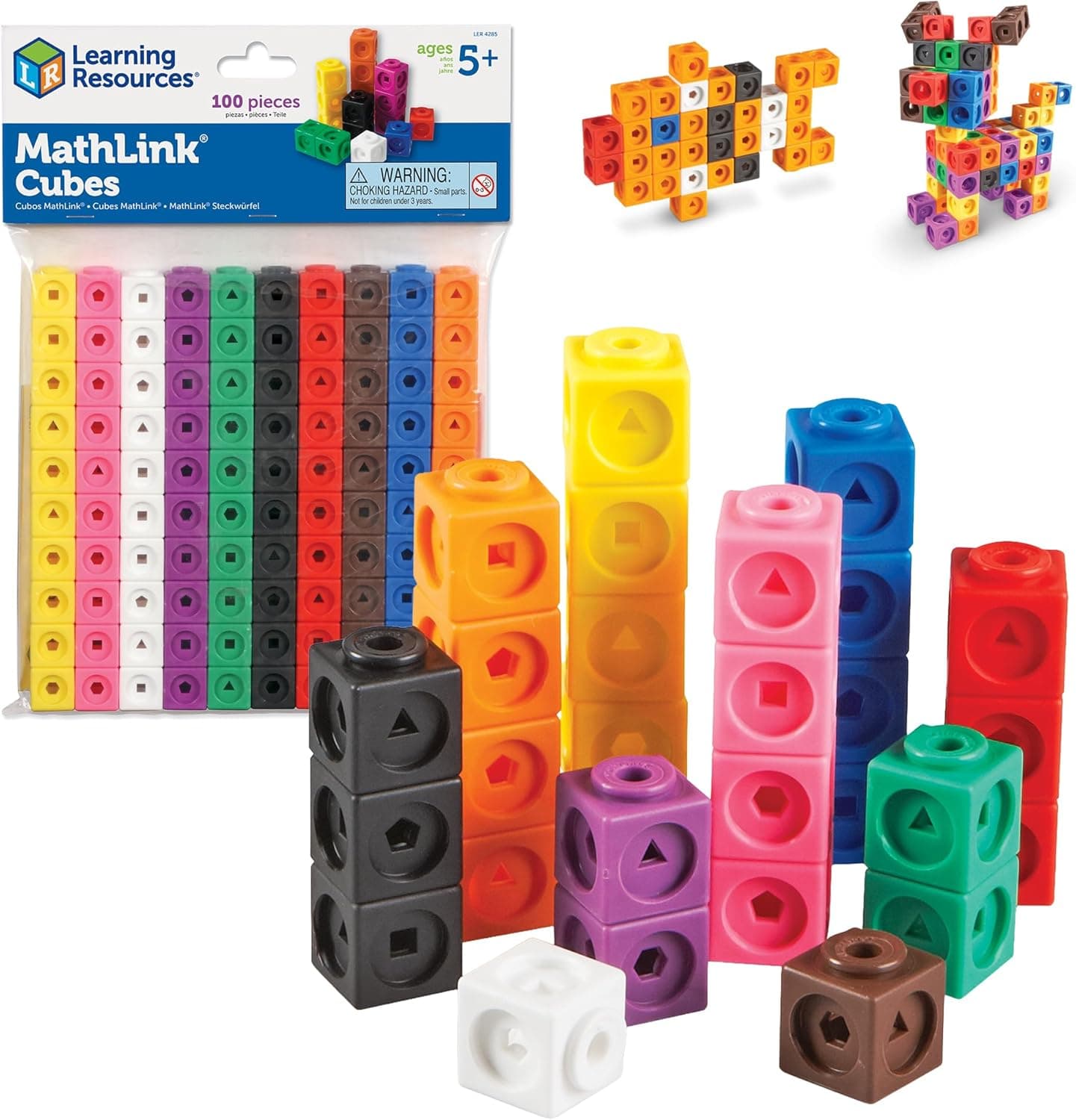
A set of 100 interlocking cubes with shape cutouts on each face, useful for counting, patterns, sorting, and building early multiplication arrays. The most versatile manipulative on this list, good for a wide range of ages at once.
Learning Resources Plastic Base Ten Starter Set
Place value is the concept that trips up more of my kids, at more different ages, than anything else in elementary math, and this is the set that finally made it click for both of my middle boys. The blue plastic units, rods, flats, and single large cube give a physical, stackable way to see that ten units really do equal one rod, and ten rods really do equal one flat, instead of just memorizing that fact for a worksheet.
I introduce this after a kid already has a solid handle on counting with the MathLink cubes, usually around first grade. We start by physically trading ten loose units for a rod every time we hit ten, over and over, until it feels automatic. That repetition is tedious some days, but it is what makes carrying and borrowing in addition and subtraction feel logical instead of like an arbitrary rule a few years later.
The included activity book is genuinely useful, not just filler. I do not use every activity in it, but the early ones on building two and three digit numbers and the later ones on regrouping have been worth returning to more than once, months after we first covered them.
Honest limitation: the pieces are made of a fairly hard plastic, and the flats in particular will crack if a determined toddler sibling gets hold of them and treats them like a frisbee, which happened once in our house. I now keep this set on a higher shelf than the MathLink cubes and only bring it down for supervised math time rather than leaving it in the general toy rotation.
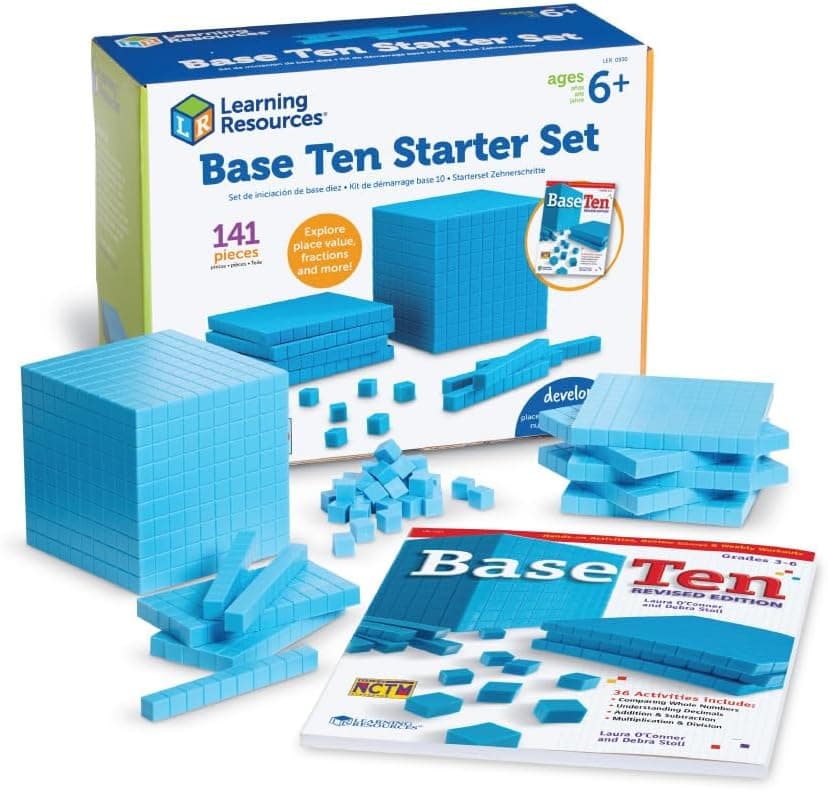
A 141 piece set of units, rods, flats, and a large cube for teaching place value, regrouping, and basic operations. Includes an activity book with lessons that hold up well for repeated use over multiple years.
Learning Resources Fraction Tower Equivalency Cubes
Fractions are where a lot of the math anxiety in our house actually started, and this set has done more to calm that down than any workbook we tried first. Each cube is labeled with a fraction, decimal, and percent, and the cubes are sized so that, for example, three of the one third cubes stack to exactly the same height as one whole cube. Seeing that physically, rather than just being told it is true, is what actually convinced my eight year old that fractions were not some abstract trick.
We use these mainly for equivalency, stacking combinations of cubes to find which fractions match, and for basic comparison, holding two towers side by side to see which is genuinely larger without any calculation first. It has also become our way of introducing decimals and percents as three ways of writing the same value, since all three are printed right on the cube.
The labeled cubes mean this set has a shorter runway than the others here once a kid moves into more advanced operations like adding fractions with unlike denominators. It is an excellent equivalency tool, but at some point a kid needs to move past the physical cubes into working the math on paper.
Honest limitation: because the labels are permanent and specific, this set does not flex into other math topics the way the MathLink cubes or pattern blocks do. It earns its shelf space purely on how well it does one job, teaching fractions, decimals, and percents as related concepts, rather than on versatility.
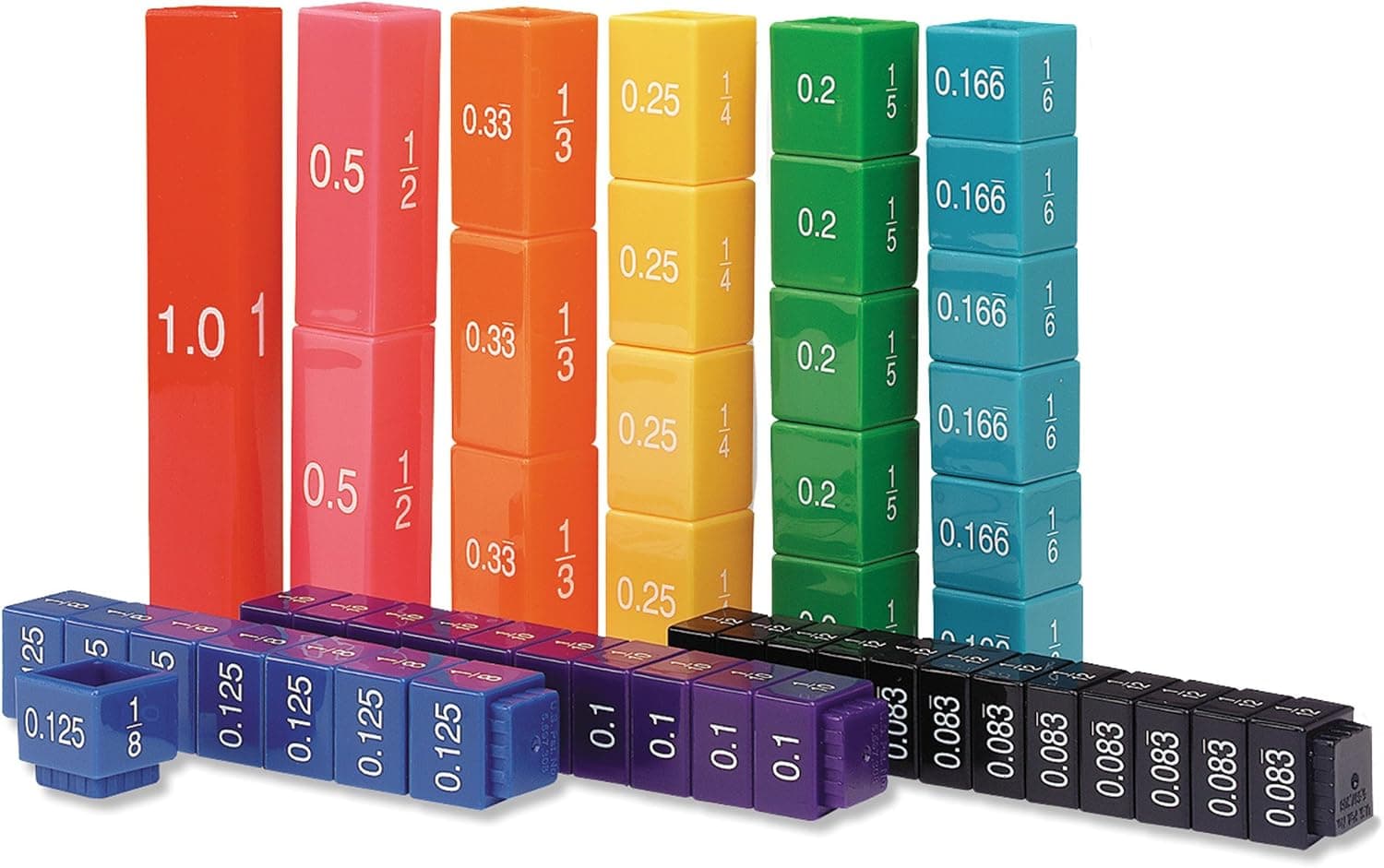
A 51 piece set of stacking cubes labeled with matching fractions, decimals, and percents, sized so equivalent values stack to the same height. Excellent for teaching fraction equivalency and comparison before moving to written fraction operations.
Learning Resources Plastic Pattern Blocks
Geometry gets far less attention in most elementary math curricula than arithmetic does, and these blocks are how we fill that gap without adding a whole separate subject to our week. The set includes hexagons, trapezoids, triangles, squares, and rhombuses in a handful of colors, and the six shapes are all sized so they fit together edge to edge in dozens of combinations.
We started using these for open ended pattern building with my younger boys, matching colors and shapes into repeating sequences, a good use of fifteen minutes before a more structured lesson. As they got older, the same blocks became our tool for symmetry, folding an arrangement in half to check whether both sides match, and for an intuitive introduction to fractions, since it takes exactly two trapezoids or three triangles to cover one hexagon.
My favorite unplanned use has been tessellation, letting the boys cover a sheet of paper with a repeating pattern and trace the outlines into their own design. It sneaks in real geometric reasoning about angles and fit while feeling entirely like play.
Honest limitation: with 250 loose plastic pieces, this is by far the messiest set on this list if it is not stored properly. Ours lives in the original clear tub with a lid, and I have learned the hard way that skipping the five minute cleanup at the end of a session means finding stray hexagons under furniture for weeks afterward.
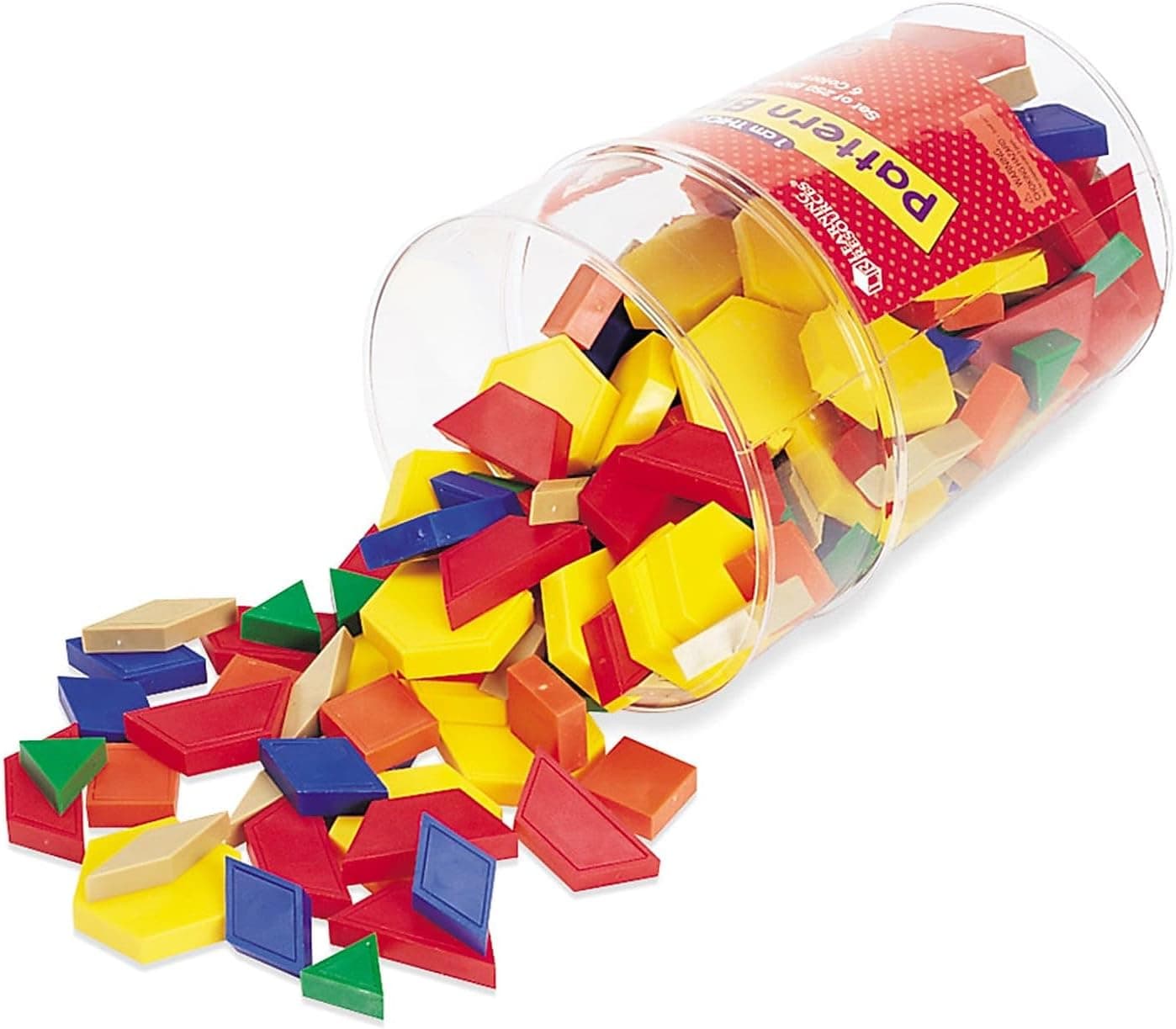
A 250 piece set of six geometric shapes that fit together for patterning, symmetry, and an intuitive first look at fractions. A good open ended option for a wide age range, best kept in a lidded tub to control the mess.
Making Manipulatives Actually Get Used
Buying the sets is the easy part. Here is what has actually kept ours in weekly rotation instead of gathering dust.
Keep them visible and accessible, not packed away in a closet. Ours live on an open shelf at kid height in our homeschool room, next to a stack of plain math workbooks we use for the written practice that follows the hands on part of a lesson. If getting a manipulative out requires digging through a closet, it quietly stops happening.
Let the manipulative come out before the worksheet, not after. I used to reach for these only when a kid was already stuck and frustrated, which meant they got associated with failure. Now I try to introduce a new concept with the blocks or cubes first and save the written page for after the idea already makes sense.
Rotate what is on the shelf instead of leaving everything out at once. Having all four sets available at all times was overwhelming and led to more building and less actual math. We keep two out at a time and swap based on what unit we are working through that month.
Do not expect one set to serve every kid the same way. My oldest reaches for the base ten blocks to check his own subtraction, while my youngest uses the exact same set just to build towers and count. That is fine. A manipulative earns its keep by being useful somewhere in the range of ages you are teaching, not by being used identically by every child.
If you are still building out your homeschool room beyond just math tools, a broader homeschool supplies search is worth a slow scroll before you commit to a full curriculum, since a lot of the supporting materials overlap across subjects.