Best Sourdough Bread Baking Supplies for Beginners
The sourdough baking supplies worth buying for beginners: a complete starter kit, two banneton options, and the one kitchen scale that makes it all work.
Sourdough has been on my list for a long time. I had the bread book. I had the intention. What I did not have was any real guidance on which supplies were actually worth buying and which ones were just clutter. When my neighbor Anna started showing up to things with loaves she had made, I finally asked her to walk me through her whole setup.
Anna has been baking sourdough for about three years and keeps two starters going in her fridge. She brought over her proofing basket, her scale, and her scoring lame one afternoon while the boys were doing their afternoon reading, and walked me through exactly what she uses and why she chose each piece. Her take was the same as every experienced sourdough baker I have talked to since: the supply list is shorter than the internet makes it sound, and the things that matter most are not the expensive things.
I picked up my own supplies a few months ago based on what Anna pointed me toward. I have been baking about once a week, mostly on school days when I am home anyway and the slow timing of sourdough fits naturally into the rhythm of the morning. The boys love the smell, my youngest has started calling it "our bread," and it has become one of those kitchen things I genuinely look forward to.
These are the sourdough supplies I would actually recommend to someone starting from scratch.
What You Actually Need
Sourdough is different from regular bread in one key way: the dough ferments slowly over hours, and it needs to hold a specific shape during that process. That changes which tools matter.
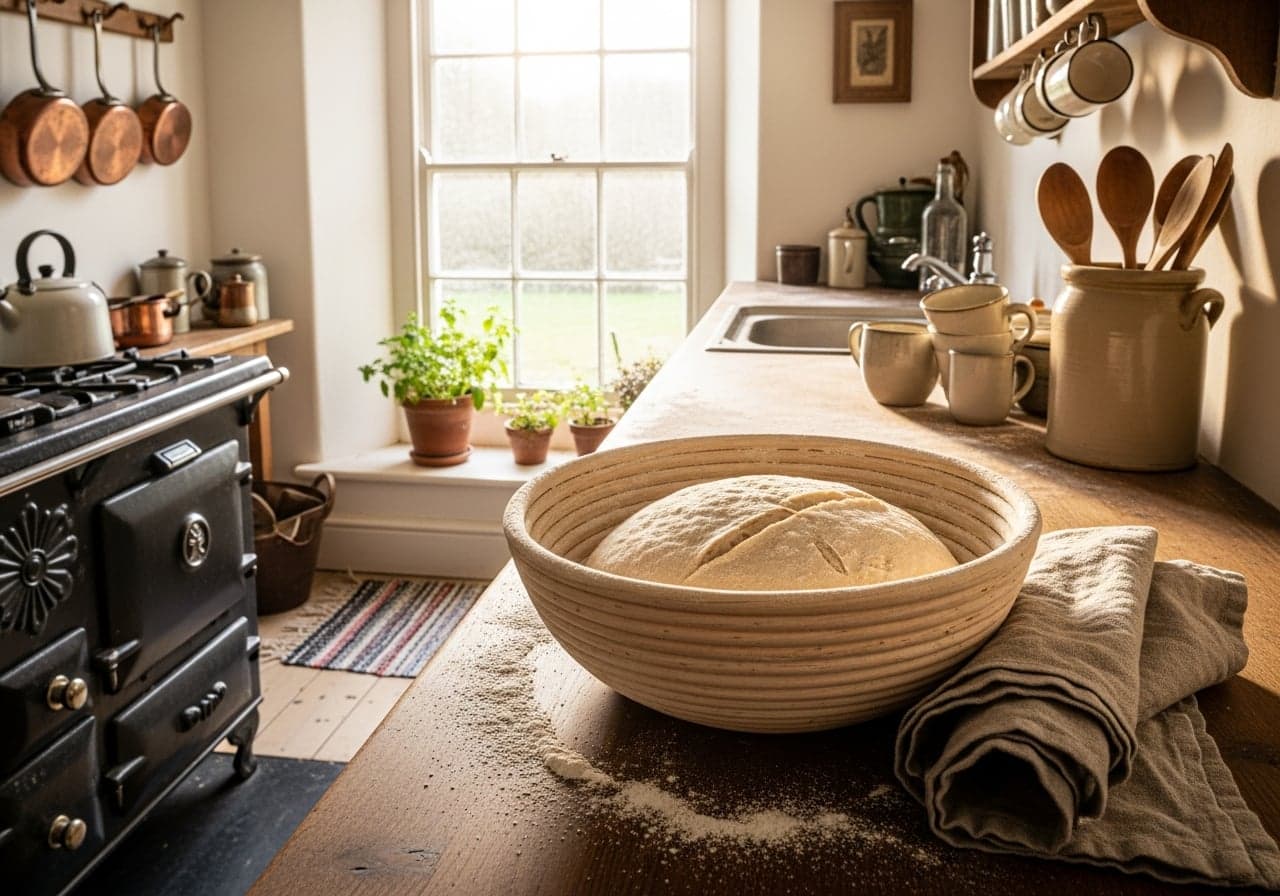
A proofing basket, called a banneton, is the one sourdough-specific piece of equipment. This is the spiral-ribbed rattan basket where the shaped dough rests and holds its form during the final rise. Without one, a wet sourdough dough will flatten out and spread rather than maintain the round shape you need. Most beginners start with a 9-inch round, which handles a standard-sized loaf.
A digital kitchen scale is the other non-negotiable. Sourdough hydration levels and starter ratios are calculated by weight, not volume, and the difference between 300 grams and 315 grams of water produces a noticeably different dough. I tried to skip this step on my first loaf. It did not go well.
A scoring lame, the small blade tool used to slash the top of the dough before it goes into the oven, rounds out the must-haves. The slash controls how the bread opens and expands. Without it, the loaf cracks unpredictably.
Everything else, the Danish dough whisk, the bench scraper, the dedicated starter jar, gets more useful once you have made a few loaves and understand your workflow. Most starter kits include them, which is part of why a kit makes sense for beginners.
At a Glance
| Pick | Best For | Key Feature | Approx. Price |
|---|---|---|---|
| CRISS ELITE Starter Kit | Total beginners, all-in-one | Banneton, jar, lame, whisk, scrapers | $35-45 |
| Culinary Couture Basket Set | Bakers who want two loaves | 2 bannetons with removable linen liners | $30-40 |
| Superbaking Banneton | Best standalone basket upgrade | Splinter-free rattan, long-term quality | $20-28 |
| OXO Good Grips Scale | The one tool you cannot skip | Pull-out display, 1-gram precision | $50-60 |
CRISS ELITE Sourdough Starter Kit
This is the kit Anna pointed me toward when I was starting out, and the one I would still recommend to someone buying their first sourdough supplies.
The CRISS ELITE kit includes a 9-inch round natural rattan banneton, a 24-ounce glass sourdough starter jar with a lid, a metal dough scraper, a plastic bowl scraper, a 5-blade scoring lame with a protective case, a Danish dough whisk, and a cleaning brush. For someone starting from nothing, that covers every basic tool needed to make a first loaf without buying pieces individually and guessing at sizing.
The banneton is unbleached natural rattan, which matters. Some cheaper baskets use other materials that do not allow moisture to release from the dough properly during proofing. The spiral ribbing on this one does two things: it gives the loaf that distinctive patterned ring you see on bakery sourdough, and it wicks surface moisture away from the dough as it proofs, which helps develop a better crust.
The 24-ounce glass starter jar is well-sized for maintaining a regular home starter. Glass is much easier to work with than opaque containers because you can actually watch the starter rise and collapse, which is how you learn its rhythm. Anna marks her jar with a rubber band at feeding time so she can track how much the starter rises over the next 8 to 12 hours.
The scoring lame comes with five replaceable blades. Blade sharpness makes a real difference, and having replacements in the box means you do not have to figure out where to source them separately when the first blade dulls.
Honest limitation: this kit does not include a kitchen scale, and a kitchen scale is genuinely the most important purchase on this list. No kit in this price range includes a good one. Plan to pair this kit with the OXO scale below from the start.
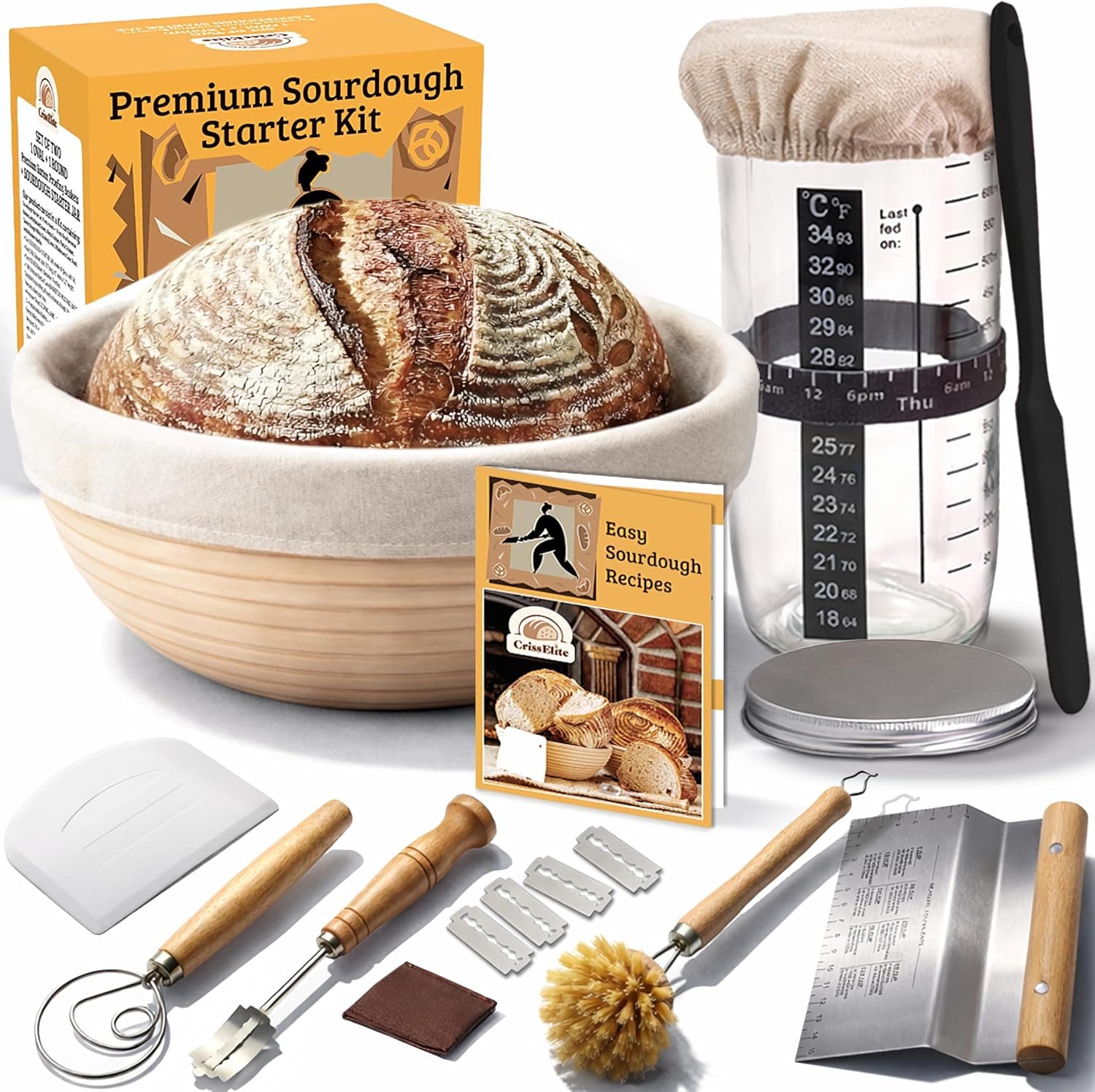
The one-box starting point for beginners. Includes a natural rattan 9-inch round banneton, 24-ounce glass starter jar with lid, scoring lame with 5 replaceable blades, Danish dough whisk, metal and plastic scrapers, and cleaning brush. Everything except a kitchen scale in a single purchase. The banneton and lame are both quality enough to keep using well past your first loaves.
Culinary Couture Bread Proofing Basket Set of 2
If you already have a starter jar and just need proofing baskets and a lame, this set gives you better value for the same money.
The Culinary Couture set includes two 9-inch round bannetons with removable linen liners, a scoring lame with multiple blades, a metal scraper, a plastic bowl scraper, and a Danish dough whisk. Two bannetons turns out to be more useful than it sounds once you settle into a rhythm. Most sourdough bakers move to two loaves at a time because the active hands-on preparation takes the same amount of time whether you are shaping one loaf or two, and the bake time is the same. You just fill the oven and get twice the bread from one session.
The removable linen liners are worth calling out specifically. When you proof dough in a bare rattan basket, the ribbing imprints a spiral pattern on the loaf. When you use the linen liner, the surface stays smooth and tight-skinned, which gives you a different finished look. Being able to choose between the two from the same basket gives you more flexibility as you figure out your preferences.
The lame in this set has a more comfortable handle than the basic wire-and-blade tools you find in single-item listings. The replacement blades are included as well.
Honest limitation: this set does not include a starter jar. If you are starting completely from scratch with no sourdough supplies at all, the CRISS ELITE kit gives you more of the essentials in one purchase. If you have a jar or can use a wide-mouth mason jar for your starter, this set is the better value.
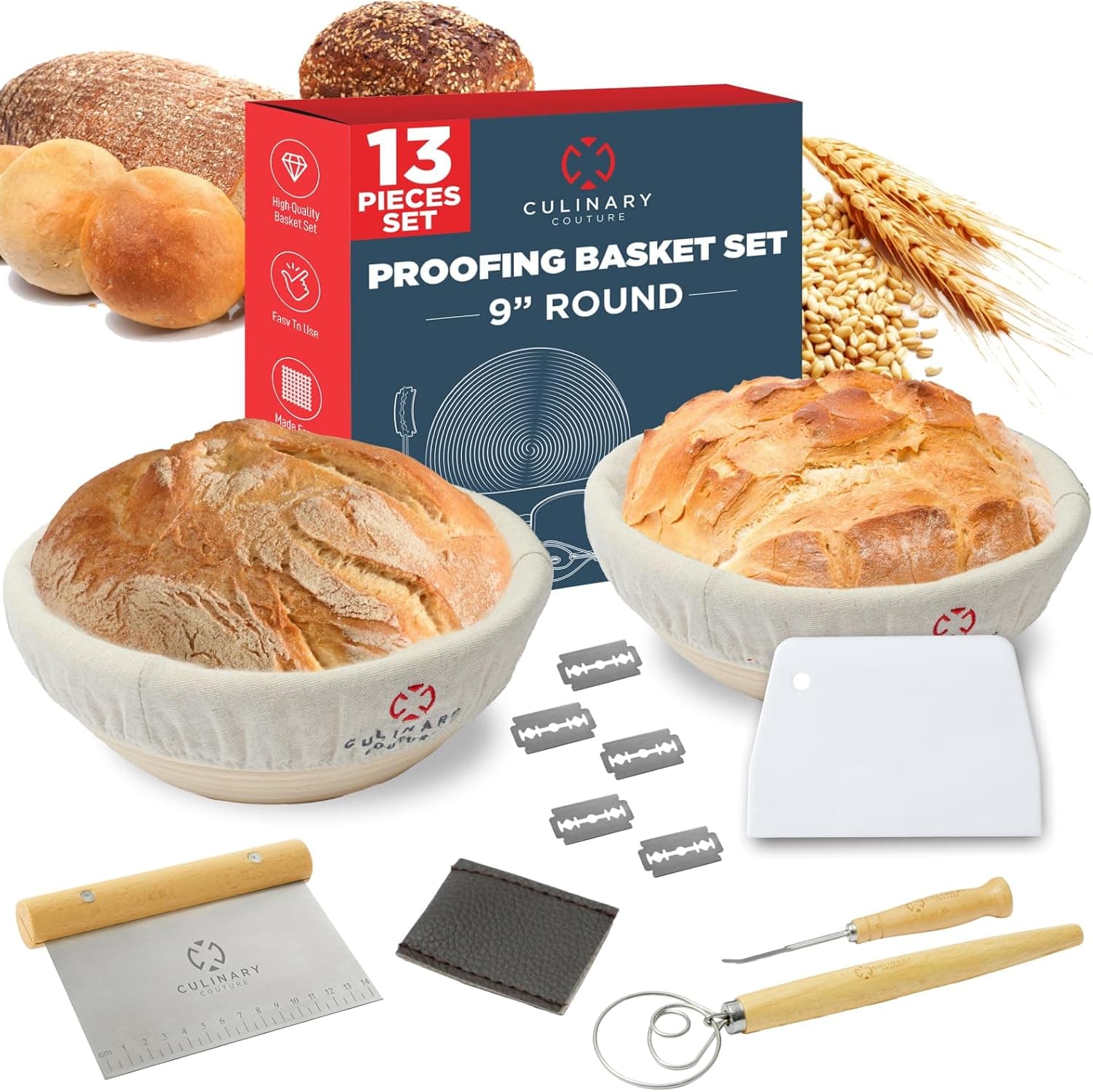
The practical choice for bakers who want to work two loaves at a time. Two 9-inch round bannetons with removable linen liners let you choose between a patterned or smooth crust surface. Comes with a lame, metal and plastic scrapers, and a Danish dough whisk. Better value than buying two separate baskets if you plan to scale up quickly.
Superbaking Banneton Bread Proofing Basket
If you already have a kit with a starter basket and want to upgrade to a single, high-quality standalone proofing basket, this is the one Anna uses.
The Superbaking banneton is a 9-inch round rattan basket that comes with a removable linen liner, a scoring lame, replacement blades, and a small cleaning brush. It is not a full starter kit, but it also is not stripped down to just the basket.
What makes this one worth buying as an upgrade is the rattan quality. A common complaint about cheaper banneton baskets is that the rattan sheds small splinters into the dough. The Superbaking basket uses tightly woven, splinter-free rattan that holds its shape through repeated use and does not shed material. After a few months of once-a-week baking, Anna's baskets look the same as when she bought them. Her older cheaper basket did not.
The basket also releases dough cleanly with proper flouring, which is the most important performance factor. A wet sourdough dough that sticks and tears when you flip it out of the basket deflates and loses all the structure you built up during proofing. A high-quality basket that releases reliably is worth the difference.
Honest limitation: if you are buying your very first sourdough supplies and have nothing at all, the CRISS ELITE starter kit is a more practical starting point because it includes the other tools you need alongside the basket. This one makes the most sense as a replacement or upgrade once you know sourdough is something you want to keep doing.
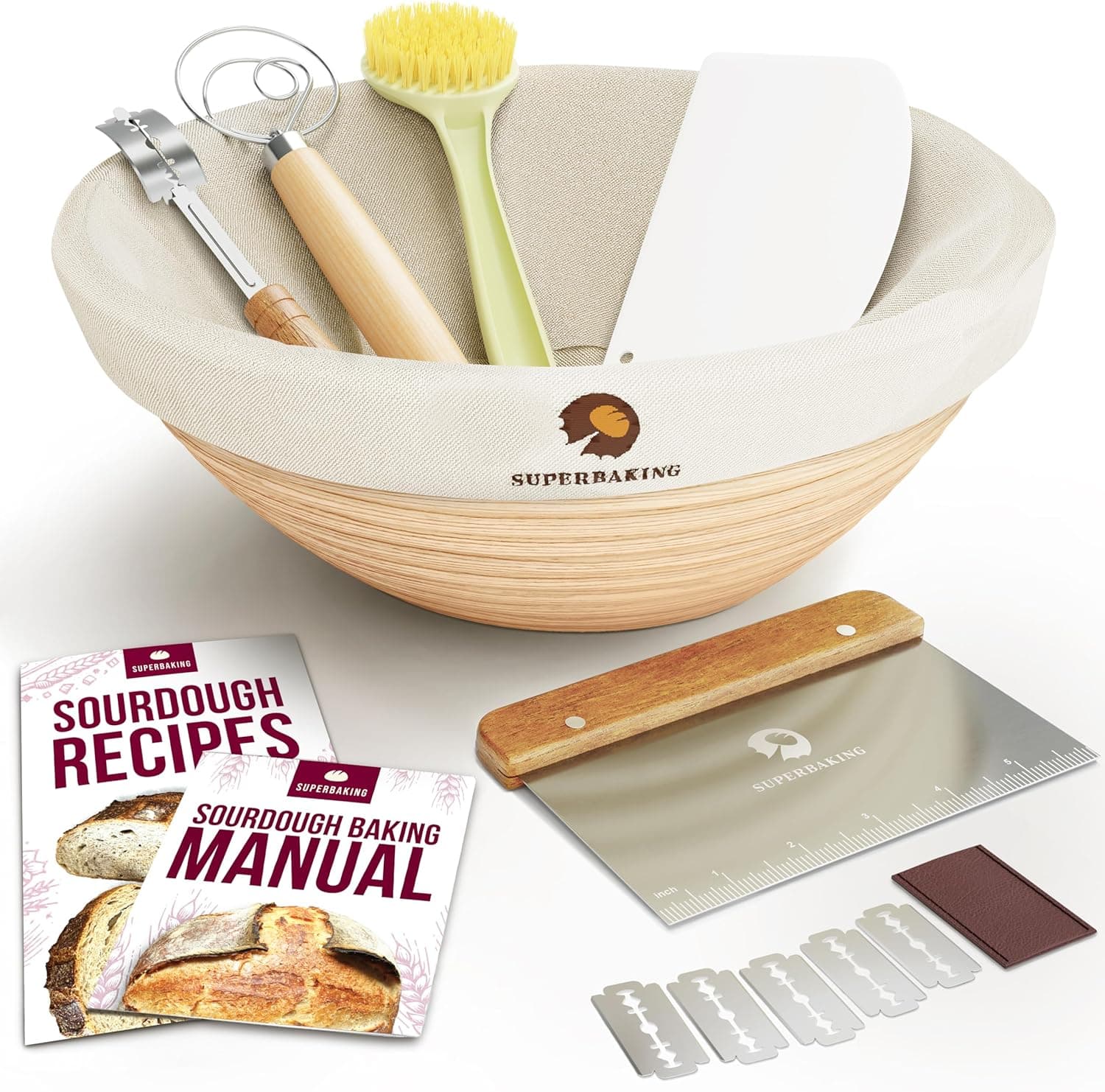
The best standalone proofing basket for bakers ready to upgrade. Splinter-free natural rattan releases dough cleanly, comes with a removable linen liner, scoring lame, replacement blades, and cleaning brush. Works for both patterned and smooth-surface loaves. A reliable, long-lasting basket that holds up to regular use better than budget options.
OXO Good Grips 11-Pound Kitchen Scale
This is the one purchase on the list I would never skip, and the one I would buy first if I had to choose.
Sourdough is fundamentally a ratios-based process. Your starter is fed at a specific ratio of flour, water, and existing starter, measured by weight. Your dough hydration is calculated by weight. Even the salt matters in grams, because the difference between 9 and 12 grams of salt changes the flavor and affects how the fermentation moves. Baking by volume with cups and tablespoons produces inconsistent results, and when a loaf does not turn out right, you cannot troubleshoot what you cannot measure.
The OXO Good Grips kitchen scale is what Anna recommended and what I bought first, and the reason is the pull-out display. When you place a large mixing bowl on a standard scale, the display disappears behind the bowl and you have to lift the bowl to check the number. The OXO display slides out from under the platform and angles upward, staying visible no matter what size bowl is sitting on top. It sounds like a small thing until you have worked around it on a cheaper scale.
It measures in 1-gram increments up to 11 pounds, which covers starter feeding, full batch dough, and large bowl mixing all on one scale. The tare function, which zeroes the scale so you can add ingredients directly to the bowl without doing math, works every time with one button. The stainless steel platform wipes clean easily, which matters on baking days when there is flour everywhere.
Honest limitation: this scale costs noticeably more than the basket kits. If budget is a real constraint and you have to prioritize, I would still take the scale first and proof dough in a floured, cloth-lined bowl until you can add a banneton. The scale affects every single loaf. The basket affects the shape and crust. Both matter, but the scale affects accuracy.
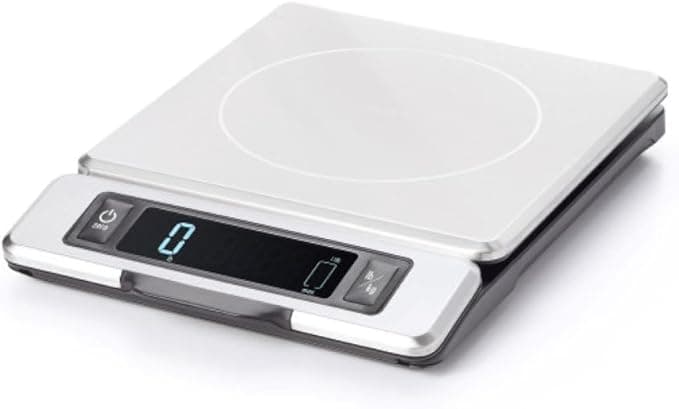
OXO Good Grips 11-Pound Stainless Steel Kitchen Scale with Pull-Out Display - Black
The non-negotiable sourdough tool. The pull-out display stays visible even with a large mixing bowl on the platform, which standard scales cannot do. Measures in 1-gram increments up to 11 pounds, simple tare function, stainless steel platform. Works for all baking and cooking, not just sourdough. Once you start weighing ingredients, you will use this for everything.
Getting Your Starter Ready to Bake
The supplies are only part of what you need. The starter is the other part, and it takes about two weeks of daily feeding before it is active enough to leaven bread reliably.
The basic process: mix equal weights of flour and water (whole wheat or rye helps the early fermentation), keep it in your jar on the counter, and feed it every 24 hours by discarding most of what you have and adding fresh flour and water. After about a week, you will start seeing it rise and fall predictably. By week two, it should double in size within 4 to 8 hours of feeding, which is the sign it is ready to use in dough.
Summer is actually a great time to start a new sourdough starter. The naturally warm kitchen temperatures speed up fermentation significantly compared to winter. What takes 8 hours in a cool January kitchen might take 4 to 5 hours in a warm June kitchen. That predictability makes it easier to fit baking into a schedule when you are home anyway, which for us means school days when the boys and I are around all morning.
Once the starter is established, Anna switched to keeping hers in the fridge and refreshing it weekly. The cold slows fermentation almost to a halt, which means you do not have to feed it every single day. You pull it out the night before you want to bake, feed it, let it get active on the counter overnight, and start your dough in the morning. That once-a-week rhythm is very manageable for a regular home baker.
The one thing I wish I had been told at the start: the first three loaves are learning loaves. They will probably be denser than you expected. That is not a sign anything is wrong with your setup or your starter. It is just the nature of sourdough, which has more variables than almost any other baking. You develop intuition for the dough by touch over several bakes, and that cannot be taught from a recipe.
Frequently Asked Questions
You'll Also Love
- Best Dutch Ovens for Home Cooking: the pot that makes sourdough crust actually crackle, and pulls double duty for everything else on the stove.
- Best Stand Mixer for Home Baking: if you are going deeper into from-scratch baking, a stand mixer handles the kneading work for enriched doughs that sourdough techniques translate into.
- Homestead Pantry Essentials: the pantry staples worth keeping stocked when you are baking bread regularly and making things from scratch throughout the week.