DIY Portable LEGO Robotics Table: Build It, Break It Down, Take It Anywhere
Step-by-step instructions for building a FIRST LEGO League competition table that folds up and breaks down for easy storage. Three designs — from a simple practice surface to a portable tri-fold table you can move from room to room. Perfect for homeschool families with limited space.
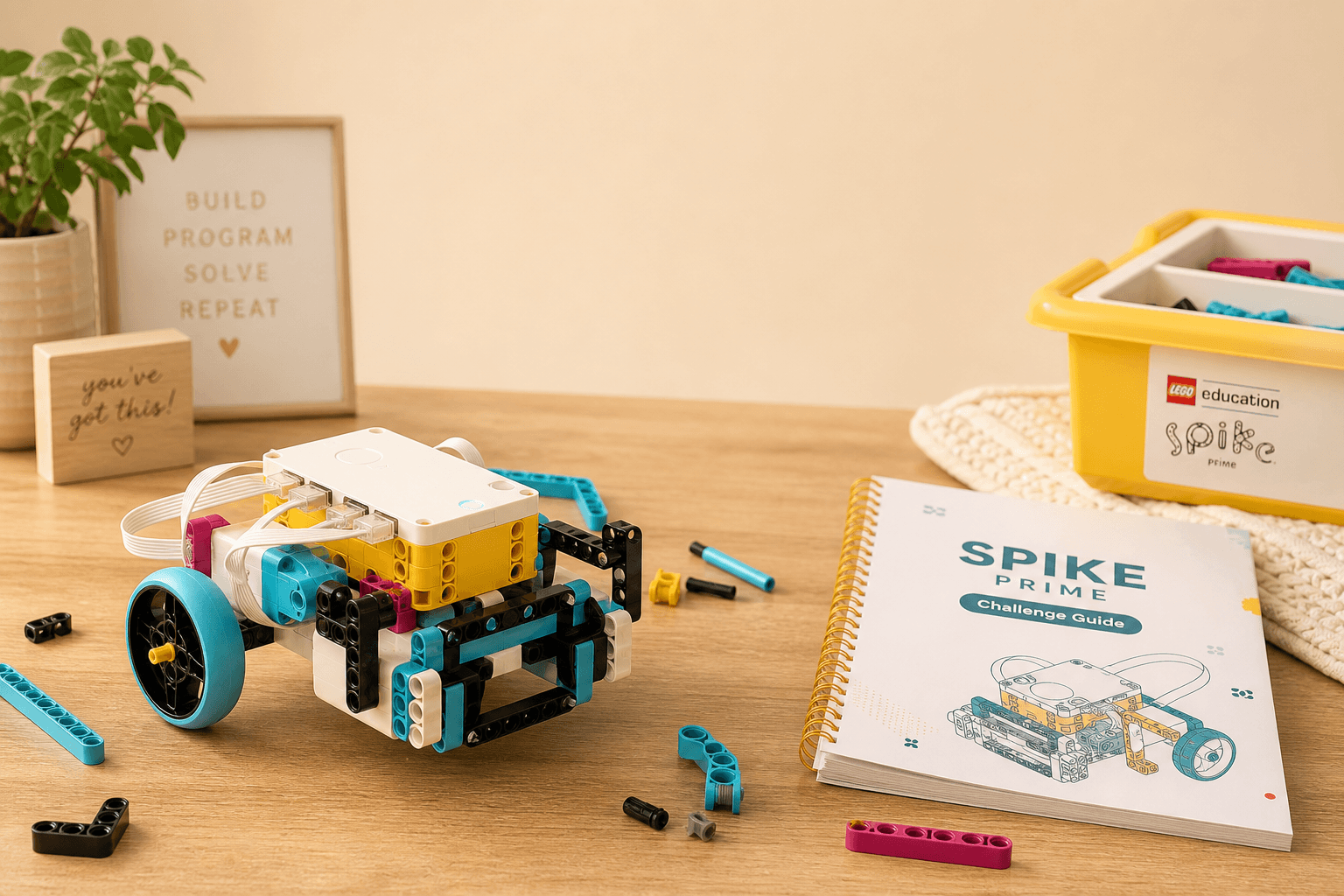
If you're getting your kids into FIRST LEGO League, the robot is the fun part. The table? That's the part nobody talks about — until you realize an official competition table is four feet by eight feet and you need to actually put it somewhere.
I am not about to dedicate half a room to a permanent robotics table. And if you're homeschooling like me, you probably can't either. So I went down the rabbit hole of portable FLL table designs, and honestly, it's way simpler than it looks. Here are three ways to build one, from the absolute easiest to the full tri-fold that rolls away into a closet.
Why You Need a Table (and Not Just the Floor)
The official FLL field mat is 93 inches by 45 inches. It has printed markings, color zones, and mission model placements that your robot needs to navigate precisely. The mat sits inside border walls (2x4 lumber) that keep the robot from driving off the edge.
You can put the mat on a clean floor, but your kids will be kneeling on hardwood for hours, the mat slides around, and the robot behaves differently than it will at a tournament. A proper table surface makes practice consistent and competition-ready.
The good news is the table is just plywood and 2x4s. Nothing fancy. Let's build one.
Materials (For All Three Designs)
No matter which version you build, the core materials are the same:
- 1 sheet of ½-inch plywood, 4' x 8' — The playing surface. Have the store cut it for you (it's free at Lowe's and Home Depot)
- 4 pieces of 2x4 lumber, 8-foot each — The border walls. You'll cut these to length
- 1¼-inch drywall screws — For attaching walls to the plywood
- Wood primer — One coat seals the surface and prevents splinters
Design 1: The Simple Practice Table (30 Minutes, ~$50)
This is the "I need something this afternoon" version. It's just a flat panel with walls that you set on sawhorses or a dining table when it's time to work, then lean against the wall when you're done.
Cuts needed (have the store do all of these):
| Piece | Dimensions | Quantity |
|---|---|---|
| Plywood base | 48" x 93" (cut from 4'x8') | 1 |
| Long border walls (2x4) | 93" | 2 |
| Short border walls (2x4) | 45" | 2 |
Steps:
-
Prime the plywood. Brush or roll on one coat of wood primer. Let it dry (about an hour). This makes the surface smooth and splinter-free — important when the field mat needs to lay perfectly flat.
-
Attach the walls. Lay the plywood on the floor or sawhorses, good side up. Screw the two 93-inch 2x4s along the long edges, flush with the top surface. Then fit the two 45-inch 2x4s between them on the short ends. Drive screws every 12–16 inches.
-
That's it. Roll out your field mat inside the walls, tape down the edges with black gaffer tape so it doesn't shift, and you're ready to practice.
Storage: This table leans flat against any wall. It's 93 inches long, so make sure you have a wall that can take it. If you don't, Design 2 is for you.
Design 2: The Tri-Fold Portable Table (2–3 Hours, ~$100)
This is the design I'm planning to build. It folds into three sections, stands on casters, and rolls through doorways. When folded, it's about the size of a large suitcase, just 32 by 48 inches and roughly 6 inches thick.
Based on a widely-shared design by Lance Salyers in the FLL community.
Cuts needed:
| Piece | Dimensions | Quantity |
|---|---|---|
| Plywood panels | 32" x 48" each (cut 4'x8' into 3 equal pieces) | 3 |
| Wall segments (2x4) | 32" long | 9 |
| Dummy wall / foot segments (2x4) | 24" long | 4 |
Additional materials:
- 2 continuous hinges (piano hinges), 8-foot each — These connect the three panels together
- 2 locking hasps — Keep the folded sections from flopping open during transport
- 4 casters (2-inch) — Swivel casters, two of them locking if you can find them
- 2 cabinet handles — For gripping when folded
- Sandpaper (120-grit) — For smoothing any rough edges
Tools needed:
- Circular saw (skip this — have the store cut)
- Power drill with screwdriver bit
- Tape measure and straight edge
- Clamps (helpful but not essential)
Steps:
1. Prime everything. Before assembly, prime all the plywood panels and 2x4 segments. One coat is enough. Let them dry completely. This step makes a huge difference in how the final table looks and feels — don't skip it.
2. Attach walls to each panel. Each 32" x 48" panel gets 2x4 walls along its two 32-inch edges. Screw from underneath — drive the screws through the plywood into the 2x4. Make sure the walls are flush with the top surface. The two 48-inch edges of each panel stay open (no walls) — these are the seams where panels connect.
For the outer panels: attach walls to both 32-inch edges AND one 48-inch edge. This gives you the complete border when the table is unfolded. Each outer panel should have walls on three sides, with the panel-connecting edge left open.
For the center panel: attach walls only to the two 32-inch edges. Both 48-inch edges stay open.
If the math is confusing: you're using 9 wall segments total — each panel gets two on the 32-inch sides (6 segments), and the outer panels each get one on the outer 48-inch edge (2 segments), plus one segment attached to the outside face of one outer panel's 32-inch wall to complete the border when flat. The last 4 short 24-inch segments become feet/dummy walls on the underside.
3. Test the fit before hinging. Lay all three panels side by side on a flat surface, walls up, and push them together. Check how the seams meet. If the wall edges stick out past the plywood, mark the excess and trim or sand it down. You want the panels to sit tight against each other with no gaps.
4. Attach the hinges. This is the trickiest part. Piano hinges go on the top side (the playing surface side). This means the table folds under itself, like closing a tri-fold brochure backwards. Why top-hinged? Because the playing surface stays protected and flat when folded — the field mat side never rubs against itself.
- Flip all three panels upside down first and push them tight together
- Lay the hinge across the seam on what will be the bottom side
- Screw it in place
Wait — actually, here's the cleaner way: attach hinges to the top surface so the panels fold under. Start with two panels, hinge them together on the top surface side, then fold them closed and test. Add the third panel the same way. The hinge pin sits in the gap between panels, and both leafs fasten to the plywood surface.
5. Test the fold. Gently fold the panels together. If anything binds, find the spot and sand or trim. The fold should be smooth — one panel folds over, then the whole thing folds again.
6. Attach locking hasps. With the table folded, position the hasps so they hold the panels tight. One on each side is usually enough. These are what keep everything from unfolding while you're rolling it around.
7. Add casters. Screw the casters to the bottom of the outer panels (the ones that end up on the bottom when folded). You want to be able to tip the folded table up and roll it like a luggage cart. If two of your casters lock, even better — the table won't wander while kids are working.
8. Add handles. Screw cabinet handles near the top edge of the outer panels (the side that faces up when the table is standing on its casters). These give you something solid to grab when tipping and rolling.
How it moves: When folded, the table is 32" x 48" x ~6". Tip it onto the casters and roll it through any standard doorway. Based on what other FLL families report, one person can move it between rooms in about 30 seconds.
Design 3: Walls-Only Frame (1 Hour, ~$30)
If you have a table, counter, or desk that's already big enough (at least 45" x 93"), you don't need plywood at all. Just the walls.
Cuts:
| Piece | Dimensions | Quantity |
|---|---|---|
| Long walls (2x4) | 93" | 2 |
| Short walls (2x4) | 45" | 2 |
Build them as two L-shaped halves that bolt together:
- Make one L-shape: screw a 93-inch piece to a 45-inch piece at the corner
- Make the second L-shape the same way
- Drill holes through the meeting ends for ¼-inch carriage bolts
- Assemble: set both L-shapes on your table, slide them together, insert bolts, tighten wing nuts
When you're done, unbolt, stack four pieces of lumber in a corner. Can't beat that for storage.
Which Design Should You Build?
Go with Design 1 if: you have a wall to lean it against and don't need to move it between rooms. It's fast, cheap, and perfectly functional.
Go with Design 2 if: you need to store the table in a closet, move it between rooms, or take it to co-op meetups. The tri-fold is an afternoon project and worth every minute.
Go with Design 3 if: you already have a large-enough table. Skip the plywood entirely.
What Else You Need
Once your table is built, here's what goes on it:
- The season field mat — Comes with your FLL Challenge registration. 93" x 45", rolls out inside the walls
- Black gaffer tape — Tape down the mat edges so it doesn't shift (gaffer tape doesn't leave residue like duct tape)
- The mission models — LEGO builds that come in your season kit. These get placed at specific spots on the mat
Tips from the FLL Community
Get the wood cut at the store. Lowe's and Home Depot will cut plywood and 2x4s to your dimensions for free. Their panel saw is way more accurate than most home circular saws.
Prime before assembly. It might feel like overkill for "just a robot table," but don't skip it. Primed wood feels better, looks cleaner, and doesn't shed splinters onto your field mat. It takes 20 minutes to roll on and an hour to dry.
Label the sections. Once your tri-fold is built, label which panel goes where (A, B, C or 1, 2, 3) with a sharpie on the underside. When you're rushing to set up before a practice session, you'll thank yourself.
Build it with the kids. This is a weekend project they can help with, measuring, holding pieces while you screw, painting the primer. I've heard from other FLL families that their kids ended up just as proud of the table as they were of the robot.
Official Table Plans
FIRST publishes season-specific table building instructions every year. For the 2025–2026 UNEARTHED season:
FIRST Inspires — Season Materials
The official plans are great, but they assume you're building a permanent 4'x8' table. The designs above are the homeschool-friendly versions adapted from years of FLL community wisdom.
If a 4'x8' table felt intimidating, I hope this made it feel more like a Saturday project. It really is just plywood, 2x4s, and screws, and once it's built, you've got a dedicated space for your kids to build, code, and compete.
Now go build something! 🔨🤖