Nature-Based Learning Activities for Homeschool Families
Discover nature-based learning activities for homeschoolers including nature journals, seasonal projects, forest school ideas, and outdoor science.

There's a particular kind of magic that happens when you take the books and worksheets away and just step outside. I've watched my kids learn more about ecosystems from an afternoon at the creek than a week of reading about them. I've seen my 7-year-old's vocabulary explode from describing what she observed in her nature journal, words like "translucent" and "serrated" and "iridescent" that she picked up naturally because she needed them to describe what she was seeing. Nature-based learning isn't a nice-to-have supplement to "real" education. For us, it's become one of the most powerful teaching tools we have. And the beautiful thing is that it works whether you live on 50 acres or in an apartment with a balcony and a park nearby.
Why Nature Education Matters
Charlotte Mason said that children should spend four to six hours outdoors every day. That felt radical when I first read it, but the more I've leaned into outdoor learning, the more I understand why she was so insistent.
Being in nature does things for kids that no indoor curriculum can replicate:
- Develops observation skills. Learning to really look, not glance, but look, at a leaf, a bird, a cloud pattern trains the kind of careful attention that transfers to every area of learning.
- Builds scientific thinking naturally. Kids outside are constantly forming hypotheses, testing ideas, and drawing conclusions. Why does moss grow on this side of the tree? Where does this water go? What happens if I stack these rocks differently?
- Supports emotional regulation. Study after study shows that time in nature reduces anxiety, improves mood, and increases focus. If your child is struggling with attention, try taking school outside before adding anything else.
- Provides multisensory experiences. The texture of bark, the sound of moving water, the smell of rain on dry earth, these sensory-rich experiences create deeper neural pathways and stronger memories than reading about them ever could.
- Builds physical fitness and gross motor skills. Climbing, balancing, hiking, digging, the body needs this as much as the mind needs books.
Starting a Nature Journal
If you do one thing from this post, make it this. A nature journal is simply a blank book where your child draws, paints, or writes about what they observe in nature. It sounds simple because it is. And it's transformative.
How to begin:
- Get a blank or lightly lined journal and some colored pencils (we also love watercolor pencils for nature journaling)
- Go outside, your backyard, a park, a trail, even a sidewalk with weeds growing through the cracks
- Find one thing to observe closely, a flower, a leaf, a bug, a bird, a rock
- Spend 10-15 minutes looking at it carefully, then drawing what you see
- Label what you can, the date, location, weather, species name if you know it
Tips for reluctant artists:
- Emphasize observation over artistic perfection. The point is training the eye, not creating gallery art.
- Start with simple things, a single leaf, the shape of a cloud, the pattern on a snail shell
- Model it yourself. Sit down and journal alongside your kids. They'll be more willing if they see you doing it too.
- For younger kids, you can scribe for them while they dictate their observations
Over time, your family's nature journals become this incredible record of what you've seen, where you've been, and how the seasons have changed. We look back through ours regularly and it's one of our most treasured homeschool keepsakes.
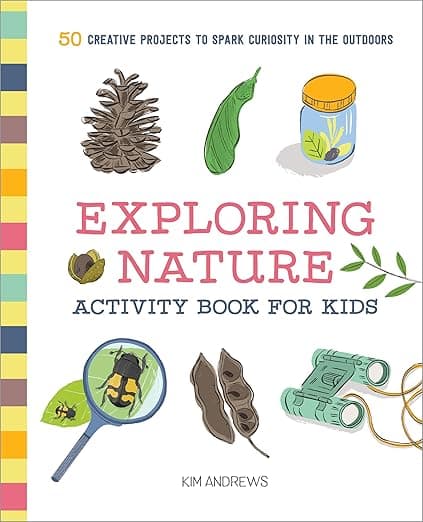
Exploring Nature Activity Book for Kids, 50 Creative Outdoor Projects
50 creative projects that get kids observing, sketching, and connecting with the outdoors -- perfect structure for reluctant artists who want just enough guidance.
Seasonal Nature Activities
One of the easiest ways to structure nature learning is to follow the seasons. Here's a starting point for each:
Spring
- Plant seeds and track their growth with measurements and drawings
- Go on a wildflower hunt and identify what you find using a field guide or an app like Seek by iNaturalist
- Observe tadpoles, nesting birds, or emerging insects
- Start a weather journal, record temperature, precipitation, cloud types, and wind direction daily
- Press flowers between the pages of heavy books for art projects later
- Study the life cycle of butterflies (you can order caterpillar kits and watch the whole process at home)
Summer
- Catch and study (then release) fireflies, beetles, or other insects
- Set up a bird bath and observe which species visit
- Go on a creek walk, look for crawdads, water bugs, smooth stones, and evidence of erosion
- Star gaze on clear nights and learn basic constellations
- Build a simple sundial and track how shadows change throughout the day
- Create a small container garden and observe pollinators at work
Fall
- Collect leaves and identify trees by their leaf shapes and bark patterns
- Study seed dispersal, how do different plants spread their seeds? Wind? Animals? Water?
- Go on a mushroom walk (observe only unless you're with an experienced forager)
- Track the changing length of days and discuss why it happens
- Create nature mandalas with found objects, pinecones, acorns, leaves, stones
- Watch for migration patterns, which birds are leaving your area?
Winter
- Study animal tracks in snow or mud
- Bring nature inside, observe pinecones, evergreen branches, or crystals forming on windows
- Learn about hibernation, migration, and adaptation, how do animals survive winter?
- Feed the birds and keep a species log of who visits your feeder
- Study snowflakes under a magnifying glass (each one really is different)
- Observe how water freezes and melts, experiment with salt, sugar, and different liquids
Forest School Concepts for Homeschoolers
Forest school originated in Scandinavia, where outdoor education in all weather conditions is a cornerstone of childhood. You don't need to enroll in a formal forest school to borrow the best parts of this philosophy.
Core forest school principles you can use:
- Regular, repeated access to the same natural space. Visit the same woods, park, or green space repeatedly over time. Kids develop a deep relationship with a place when they see it change through seasons.
- Child-led exploration. Resist the urge to turn everything into a lesson. Let your kids wander, wonder, and follow their own curiosity. The learning happens naturally.
- Risk within reason. Forest school encourages appropriate risk-taking, climbing trees, using real tools, navigating uneven terrain. These experiences build confidence, judgment, and physical capability.
- All weather is good weather. Rain, cold, wind, these aren't reasons to stay inside. They're opportunities to learn. (Good gear helps. A lot.)
- Process over product. The value is in the doing, not the finished craft or the completed worksheet. Building a dam in the creek and watching it fail three times teaches more than any worksheet about water flow.
Simple forest school activities:
- Build shelters from fallen branches and leaves
- Whittle sticks with a safe knife (supervised, of course)
- Make mud kitchens and nature potions
- Create rope swings or balance beams from logs
- Build fairy houses from natural materials
- Dig in the dirt, no agenda, just digging
- Follow an animal trail and see where it leads
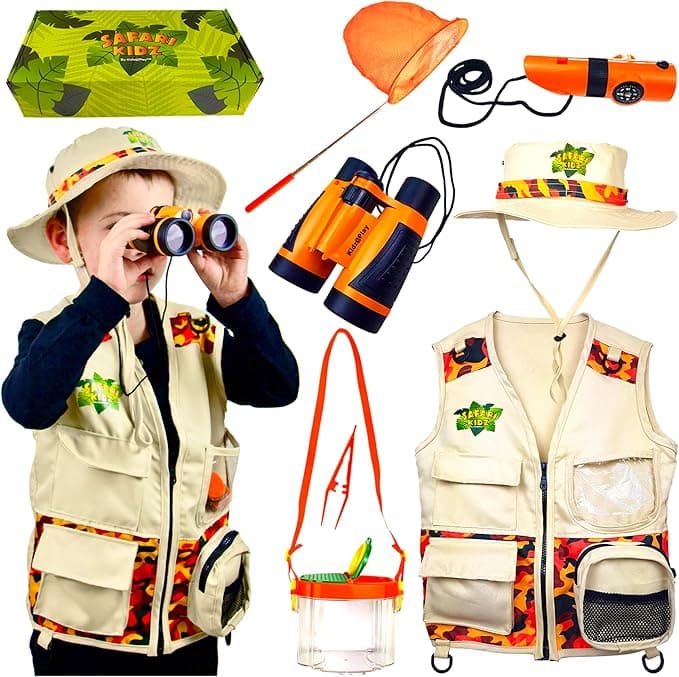
Kidz@Play Bug Hunting Kit, Binoculars, Magnifier, Compass, Net, and Explorer Vest for Kids
A good explorer kit turns every walk into an adventure -- the magnifying glass alone has given us some of our best nature journal entries when the kids discover details they never would have noticed with bare eyes.
Science Through Nature
You might not realize it, but an afternoon outside covers an enormous amount of science curriculum. Here's how nature study maps to standard science topics:
Biology: Plant identification, animal behavior, life cycles, ecosystems, food chains, anatomy (comparing skeletal structures of different animals), habitats, adaptation
Earth science: Rock and mineral identification, erosion, weather patterns, water cycle, soil composition, geological features
Physics: Simple machines in nature (levers, inclined planes), gravity experiments, sound and echoes, light and shadows, water flow and pressure
Chemistry: Why leaves change color (chlorophyll breakdown), composting (decomposition), crystal formation, how salt affects freezing
Ecology: Interdependence of living things, the impact of humans on natural spaces, conservation, biodiversity
You don't need a textbook to teach these concepts. You need a curious kid and a patch of ground. The textbook can come later to formalize what they've already experienced firsthand.
Making It Work in Urban Spaces
Not everyone has easy access to forests or wide open spaces, and that's completely okay. Nature-based learning works in cities too:
- Parks are your best friend. Even small neighborhood parks have trees, birds, insects, and weather to observe.
- Balcony or windowsill gardens teach plant biology, responsibility, and patience.
- Urban wildlife is everywhere. Pigeons, squirrels, hawks, insects, weeds growing through sidewalk cracks, it all counts.
- Nature centers and botanical gardens often have free or low-cost memberships and educational programs.
- The sky is always there. Cloud identification, moon phases, sunrise/sunset times, and basic astronomy don't require any green space at all.
The goal isn't to replicate a wilderness experience. It's to cultivate the habit of observing, questioning, and connecting with the natural world wherever you happen to be.
Just Go Outside
If all of this feels like a lot, here's the simplest possible version: go outside with your kids for 30 minutes a day. Don't plan anything. Don't bring a lesson. Just go. Let them lead. Watch what catches their attention. Ask open-ended questions. Sit on the ground with them and look at something small.
That's nature-based learning. Everything else is just a beautiful elaboration on that simple idea.