Homeschooling on a Budget: Free and Low-Cost Resources
Homeschool without breaking the bank. Discover free curricula, library programs, co-ops, YouTube channels, and low-cost resources for every subject.

Let me dispel a myth right out of the gate: you do not need to spend thousands of dollars to homeschool well. You just don't. I've seen families drop $2,000+ on boxed curricula before their first year even starts, and I've seen families educate beautifully with a library card, a printer, and some determination. The resources available for free or at very low cost today are genuinely incredible, better, in many cases, than the expensive packaged options. If money is tight (or even if it isn't and you just don't see the point of overspending), this post is your starting point. I'm going to walk you through the best free and budget-friendly resources I know, organized by category.
Your Library is Your Best Resource
I cannot overstate this. Your public library is the single greatest homeschool resource available, and it costs you nothing. Here's how to get the most out of it:
Books, obviously. But not just any books, ask your librarian for help building reading lists by subject or time period. Many libraries have homeschool-specific resource sections or can do interlibrary loan for harder-to-find titles.
Digital resources. Most library systems offer free access to things like:
- Libby/OverDrive for ebooks and audiobooks
- Kanopy for documentary and educational streaming
- Hoopla for audiobooks, movies, and music
- PressReader for magazines and newspapers
- Some libraries even offer free access to language learning apps, genealogy databases, and educational platforms
Programs and events. Many libraries host homeschool-specific programs, book clubs, STEM activities, art workshops, author visits, and reading challenges. Check your library's events calendar regularly.
Homeschool library cards. Some states offer special library cards for homeschool families that allow more checkouts or longer borrowing periods. Ask your librarian about this.
Summer reading programs. Free, motivating, and often come with small prizes. We do them every year.
Seriously, if you're homeschooling on a tight budget, make the library your first stop, your weekly ritual, and your best friend.
Free Curricula and Full Programs
There are several completely free, comprehensive curriculum options available online:
Ambleside Online, A Charlotte Mason curriculum with full book lists, schedules, and teaching guides for grades 1-12. This is what we started with and it's genuinely excellent. You'll need to source the books (library!) but the planning is all done for you. amblesideonline.org
Easy Peasy All-in-One Homeschool, A complete K-12 curriculum that's entirely online and completely free. Christian-based. Each day's lessons are laid out with links, videos, and assignments. You can literally open the website and start homeschooling today. allinonehomeschool.com
Khan Academy, The gold standard for free math instruction, and it's expanded to include science, computing, history, and more. The math courses are especially strong, clear explanations, practice problems, and progress tracking. khanacademy.org
CK-12, Free digital textbooks, interactive simulations, and practice exercises for math and science. Great for middle and high school students. ck12.org
Core Knowledge, Free downloadable curriculum guides and resources for K-8 based on E.D. Hirsch's Core Knowledge Sequence. Particularly strong for history and science. coreknowledge.org
YouTube Channels Worth Knowing
YouTube is an absolute goldmine for homeschoolers. Here are some channels that are educational, well-produced, and genuinely engaging:
Science:
- SciShow / SciShow Kids, Engaging, well-researched science videos on every topic imaginable
- National Geographic Kids, Beautiful footage, age-appropriate content
- The Dad Lab, Simple science experiments using household materials
History:
- Crash Course (by John and Hank Green), World history, U.S. history, literature, science, and more. These are fantastic for middle and high school students
- Liberty's Kids (full episodes available), Animated series about the American Revolution. My kids loved this
Math:
- Math Antics, Clear, visual explanations of math concepts from basic arithmetic through pre-algebra
- Numberphile, For kids who love math and want to go deeper into fascinating number theory
Art and Music:
- Art for Kids Hub, Step-by-step drawing tutorials for all ages. We use these weekly
- Classical Music for Kids playlists, Great for background during morning basket or composer study
General:
- TED-Ed, Short, beautifully animated lessons on a huge range of topics
- Homeschool Pop, Made specifically for homeschoolers, covering social studies, science, and language arts
Co-ops, Meetups, and Community Learning
Homeschool co-ops are groups of families who come together regularly to learn, share teaching responsibilities, and socialize. Many are free or very low-cost (dues might cover supplies or space rental).
What co-ops typically offer:
- Group classes taught by parent volunteers (each parent teaches to their strengths)
- Science labs, art classes, PE, drama, and other hard-to-do-alone subjects
- Field trips organized as a group (often with group pricing)
- Social time for kids and support time for parents
- Some co-ops are more structured (weekly classes, homework, grades) and some are more relaxed (park days with optional enrichment activities)
How to find one:
- Search Facebook for "[Your City] Homeschool Co-op" or "[Your County] Homeschool Group"
- Check with local churches and community centers, many host co-ops
- Ask at your library, librarians often know the local homeschool community
- State homeschool organizations usually maintain directories of local groups
If there isn't one near you, consider starting a small one. Even three or four families meeting weekly at a park can be incredibly valuable. One parent teaches art, another does a nature walk, someone brings a science experiment. Everybody contributes, everybody benefits.
Used and Secondhand Materials
You'd be amazed at how much homeschool curriculum is available used:
Where to buy used:
- HomeschoolClassifieds.com, The big one for used curriculum
- Facebook Marketplace and homeschool buy/sell/trade groups, Search for local and national groups
- ThriftBooks and Better World Books, Used books at great prices, often with free shipping
- Curriculum sales and swaps, Many co-ops and homeschool groups host annual used curriculum sales. These are goldmines.
- Your local thrift store, You'd be surprised how often quality workbooks, educational games, and reference books show up
Things that are great to buy used:
- Literature and read-aloud books
- History and science reference books
- Manipulatives and educational games
- Teacher guides and planning resources
- Full curriculum sets from families who've aged out of a level
Things you might want new:
- Consumable workbooks that have already been written in (though sometimes parents buy two, one to write in and one to keep clean for the next kid)
- Materials where you need the current edition for online access codes
Free Printables and Downloadable Resources
The internet is overflowing with free printable worksheets, activities, and planners for homeschoolers:
- Teachers Pay Teachers has a huge free section, filter by price to find thousands of free resources sorted by subject and grade level
- Education.com offers free printable worksheets and activities
- Starfall for early reading (free online version)
- EPA and National Park Service websites have free educational materials and junior ranger programs
- State-specific resources, Many state departments of education, museums, and parks offer free educational materials
A word of caution: it's easy to go overboard with printables and end up with a disorganized pile of worksheets that nobody uses. Be selective. Print what you'll actually use in the next week or two, not everything that looks good.
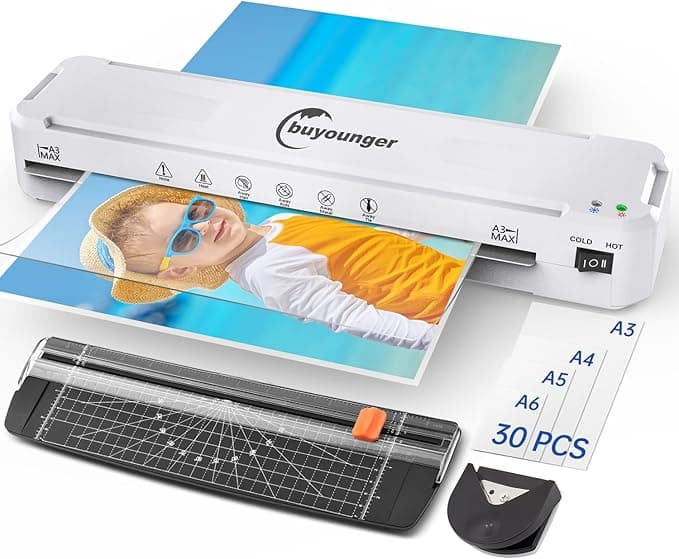
Buyounger Laminator Machine with 30 Laminating Sheets, A3/A4/A5/A6
A laminator is the ultimate budget homeschool hack. Laminate worksheets, flashcards, and chore charts once and reuse them with dry-erase markers over and over instead of reprinting. This one comes with 30 pouches to get you started and handles everything from small flashcards up to 13-inch pages.
Budget-Friendly Subject Solutions
Here's a quick breakdown of how to cover major subjects without spending much:
Math: Khan Academy (free), library math books, Math Mammoth (affordable digital download), or used copies of Saxon, Singapore, or Teaching Textbooks
Language Arts: Library books for reading, free writing prompts online, narration (telling back) costs nothing and is one of the most effective language arts tools there is
History: Library books organized by time period, YouTube documentaries, Crash Course, free living books from Project Gutenberg, used copies of Story of the World
Science: Nature study (free), kitchen experiments with household ingredients, YouTube channels, library books, free virtual labs online
Art: Art for Kids Hub on YouTube, library art books, basic supplies from the dollar store (construction paper, paint, crayons), nature art with found materials
Music: YouTube for composer study, free music apps, library audiobooks of musical stories, singing together (free and wonderful)
Foreign Language: Duolingo (free), library language books, YouTube channels in target languages, finding a native-speaking friend or family for conversation practice
The Mindset Shift
Here's what I want you to take away from all of this: expensive does not mean better. Some of the most meaningful learning in our homeschool has been completely free, a long conversation about something that sparked curiosity, an afternoon at the creek, a library book that changed how my child sees the world.
The curriculum companies want you to believe that you need their $500 boxed set to educate your child properly. You don't. You need intention, consistency, a library card, and an internet connection. Everything else is a bonus.
Start with what's free. Add paid resources only when you've identified a genuine need that free options can't fill. Your budget will thank you, and your kids won't know the difference, because the quality of free resources available today is genuinely outstanding.