Best Air Purifiers for Home That Actually Work
The best HEPA air purifiers for home tested across bedrooms, living rooms, and large spaces. Honest picks from Levoit, Coway, and Winix for families.
I did not think much about the air inside my house until the spring we moved to Stafford. We came from a condo with smaller, sealed rooms, and suddenly we were dealing with a house that had a lot more square footage to heat, cool, and apparently fill with pollen from the woods behind us. My four boys are home with me all day for school, and I started noticing that allergy symptoms, the sneezing, the itchy eyes in the morning, were showing up every spring without fail. I had always just assumed that was life.
A neighbor mentioned she had put air purifiers in a couple of rooms and noticed a real difference in how everyone felt during pollen season. I was skeptical but desperate enough to try it. That was a couple of years ago, and at this point I have run four different models through their paces across different rooms in the house. The short version: they work, but not all of them work equally well, and the specs that matter are not always the ones that are marketed most loudly.
These are the four I would actually recommend right now, across different budgets and room sizes.
What to Look For Before You Buy
The one spec that matters most is CADR, which stands for Clean Air Delivery Rate. It measures how quickly the unit cleans a specific volume of air, rated separately for smoke, dust, and pollen. A higher CADR number means faster, more effective cleaning. The AHAM (Association of Home Appliance Manufacturers) certification is worth looking for because it means the CADR numbers were tested by an independent lab rather than self-reported.
True HEPA filtration captures 99.97% of particles at 0.3 microns, which covers pollen, dust, pet dander, mold spores, and most bacteria. "HEPA-type" or "HEPA-style" filters are not the same thing and are not held to the same standard. I only recommend units with certified True HEPA filters.
Noise level matters more than most reviews acknowledge. A unit that runs loud on any setting will get turned off, and a turned-off air purifier does nothing. Look for units that run under 30 dB on low or sleep mode. For a bedroom, quieter is non-negotiable.
Filter replacement cost is the ongoing expense that most buyers underestimate. A $100 unit with $60 annual filters and a $200 unit with $25 annual filters are a different value proposition over three years. I include filter costs in my assessment of each model.
Room coverage claims often use the "at two air changes per hour" calculation, which is the bare minimum for meaningful filtration. For allergy control you want closer to four or five air changes per hour, which means the practical effective coverage is roughly half to a third of what the marketing headline says.
At a Glance
| Pick | Best For | CADR (Dust) | Room Size (5x/hr) | Approx. Price |
|---|---|---|---|---|
| Levoit Core 300-P | Bedrooms, small spaces | 141 CFM | ~215 sq ft | Under $100 |
| Coway AP-1512HH | Best overall, medium rooms | 246 CFM | ~360 sq ft | $120-$140 |
| Winix 5500-2 | Best value with carbon | 232 CFM | ~360 sq ft | $150-$170 |
| Levoit Core 400S-P | Large rooms, smart WiFi | 260 CFM | ~400 sq ft | $180-$200 |
Levoit Core 300-P
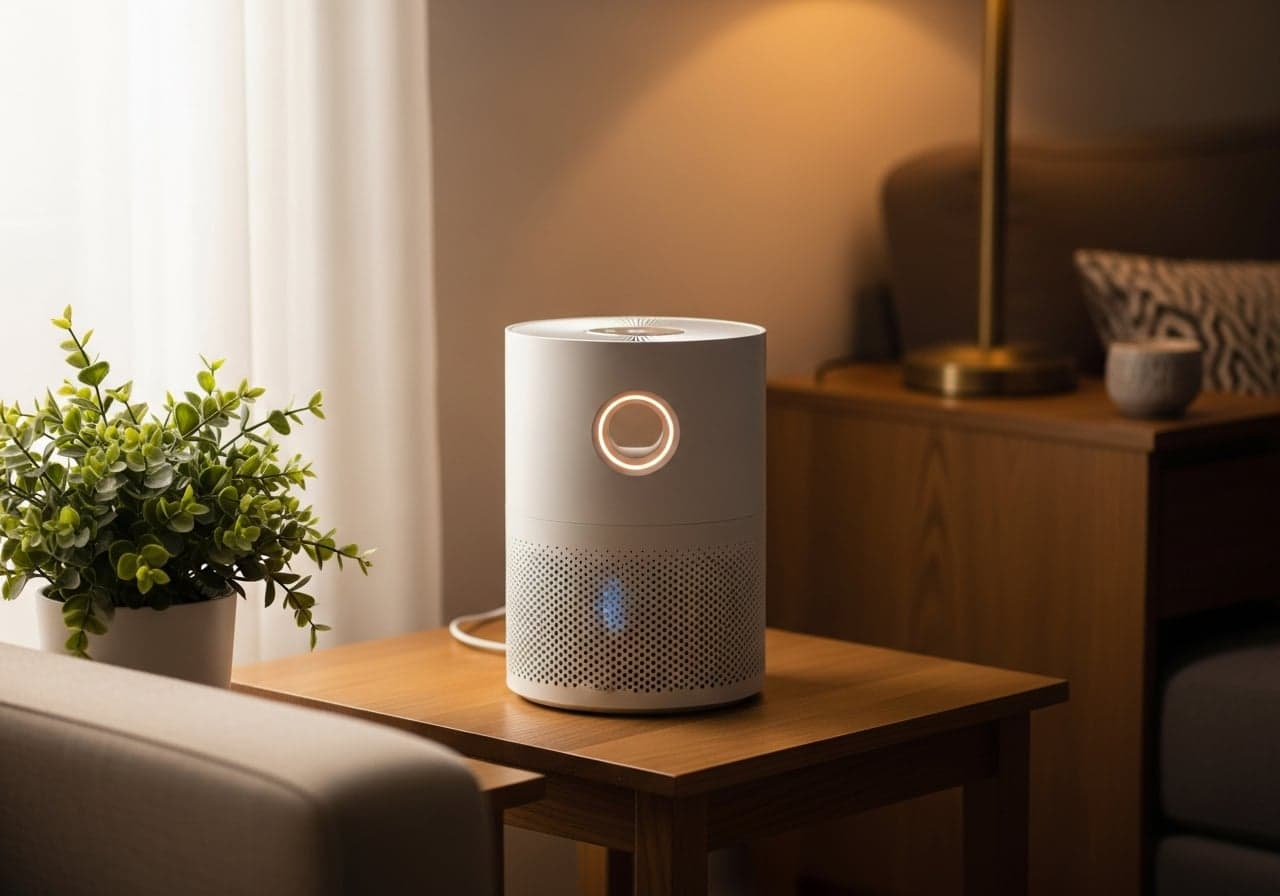
The Core 300-P is where I send anyone who wants to start with one unit without committing to a big purchase. It is compact enough to sit on a nightstand or a corner shelf without taking over the room, and the cylindrical design draws air in from all sides, which makes placement flexible. I have one in my bedroom and it is genuinely the reason I wake up with clearer sinuses during pollen season than I used to.
The 3-in-1 filter inside handles pre-filtration, True HEPA, and activated carbon in a single sealed unit, which makes replacement straightforward. You just pull out the old one and drop the new one in, no separate pieces to track. The replacement filter runs about $18 to $22 and Levoit recommends changing it every six to eight months depending on how hard it is working.
Sleep mode drops the fan to its lowest setting and turns off the display light entirely, which I appreciate for a bedroom unit. The lowest setting runs at about 24 dB, which is roughly the level of a quiet whisper. I genuinely cannot hear it from across the room.
The honest caveat: this is sized for smaller rooms, up to about 215 square feet at five air changes per hour. It would be underpowered in an open living area or a large bedroom. If the space is under 200 square feet, it is excellent. If it is bigger, step up to the Coway or Winix.
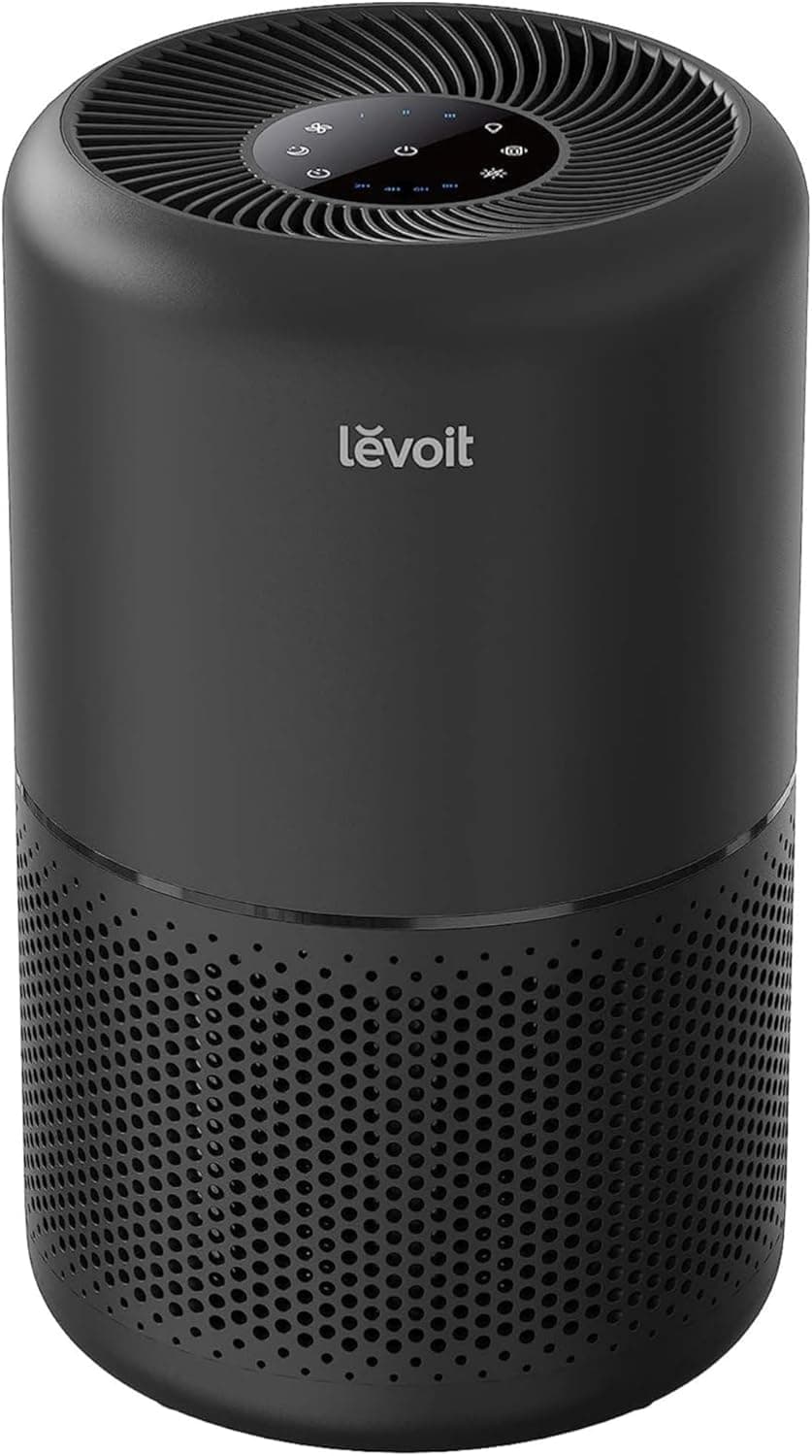
LEVOIT Air Purifier Core 300-P, AHAM VERIFIDE, True HEPA 3-in-1 Filter, Sleep Mode
My bedroom pick. Compact cylindrical design, True HEPA 3-in-1 filter, 24 dB sleep mode with display-off option. AHAM VERIFIDE CADR of 141 CFM. Best for rooms under 215 square feet. Filter replacement is simple and affordable. Under $100, and the filter costs around $20 every six to eight months.
Coway Airmega AP-1512HH
This is the unit I recommend most often to people who ask me what to buy. It has been a best-seller in the air purifier category for years and has earned that position through genuine performance rather than just marketing. The CADR of 246 CFM for dust is one of the highest in its price range, and it covers a real 360 square feet at meaningful filtration frequency.
What I appreciate most about the Coway AP-1512HH is the air quality indicator on the front face. It is a small LED that shifts color based on what the built-in air quality sensor is detecting, blue when the air is clean, yellow or pink when it detects a spike in particulates. The first time I ran it in our living room, it was on pink for about 20 minutes after I ran the vacuum, then gradually shifted to blue as it cleaned. That visual feedback was actually motivating in a way I did not expect.
The Eco Mode feature turns the unit off when the air quality sensor detects consistently clean air and turns it back on when particulates rise again. This extends filter life and keeps energy use reasonable. On Eco Mode, operating cost is around $1.50 per month in electricity.
The filter replacement cost is worth knowing upfront. The combined filter set (True HEPA plus carbon) runs about $30 to $40 and should be replaced every 12 months under typical use. That is a manageable ongoing cost and lower than what some competitors charge.
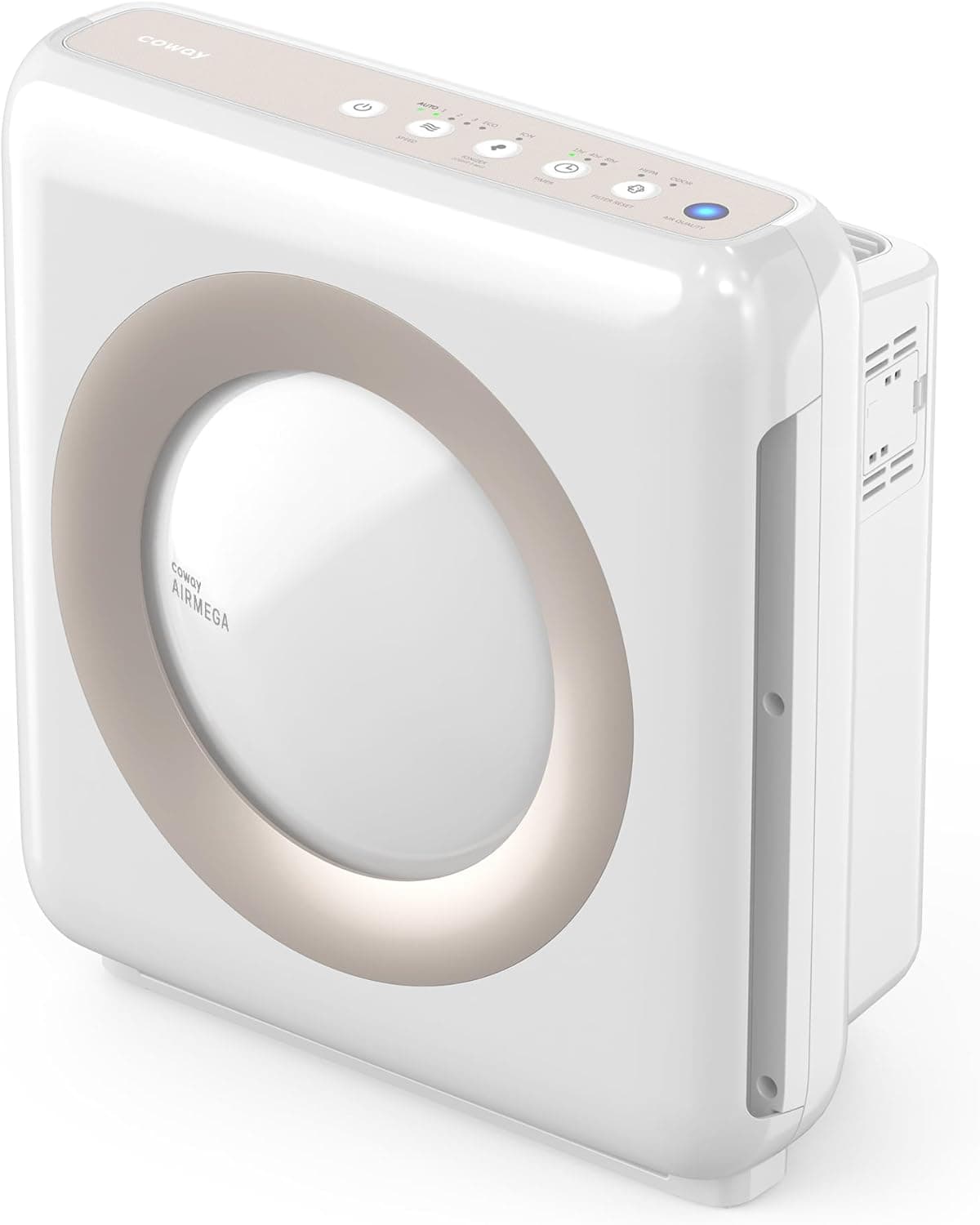
Coway Airmega AP-1512HH True HEPA Air Purifier with Air Quality Monitoring, Auto Mode, Eco Mode
My top recommendation for most people. 246 CFM CADR, real-time air quality indicator with color-coded LED, Eco Mode that powers down when air is clean. Covers 360 square feet effectively. Annual filter cost around $30 to $40. Has been one of the top-rated air purifiers in its category for years and consistently earns that position in independent testing.
The one limitation I want to flag: it does not have smart WiFi connectivity or app control. If being able to schedule or monitor from your phone matters to you, look at the Levoit Core 400S-P instead. But if you do not need app control, the Coway delivers the best filtration-per-dollar I have found.
Winix 5500-2
The Winix 5500-2 is what I reach for when someone has noticeable odors to deal with alongside particles, whether that is cooking smells, a musty basement, or a home with pets. Where the Coway relies on True HEPA plus a standard carbon layer, the Winix has a washable AOC (Advanced Odor Control) carbon filter that can be cleaned and reused instead of replaced every cycle. That reduces ongoing filter costs meaningfully.
PlasmaWave is Winix's proprietary air-cleaning technology that generates hydroxyls to neutralize bacteria, viruses, and chemical vapors at the molecular level. There is ongoing debate in the air purifier community about whether consumer ionizer technology like this is worth using, and some people prefer to run the unit with PlasmaWave off to avoid any trace ozone production. I keep it on because the levels produced are far below the EPA limit, but it is worth knowing you have the option to disable it.
The auto mode on the Winix is responsive. It uses a particle sensor and an odor sensor together to adjust fan speed in real time. When I run the oven and something burns slightly, the fan ramps up within a minute or two and then settles back down once the air clears. That responsiveness makes a practical difference in a kitchen-adjacent area.
Filter replacement for the True HEPA component runs about $50 every 12 months. The carbon filter is washable and only needs replacement every few years, which makes the Winix one of the more economical options over a three-year horizon.
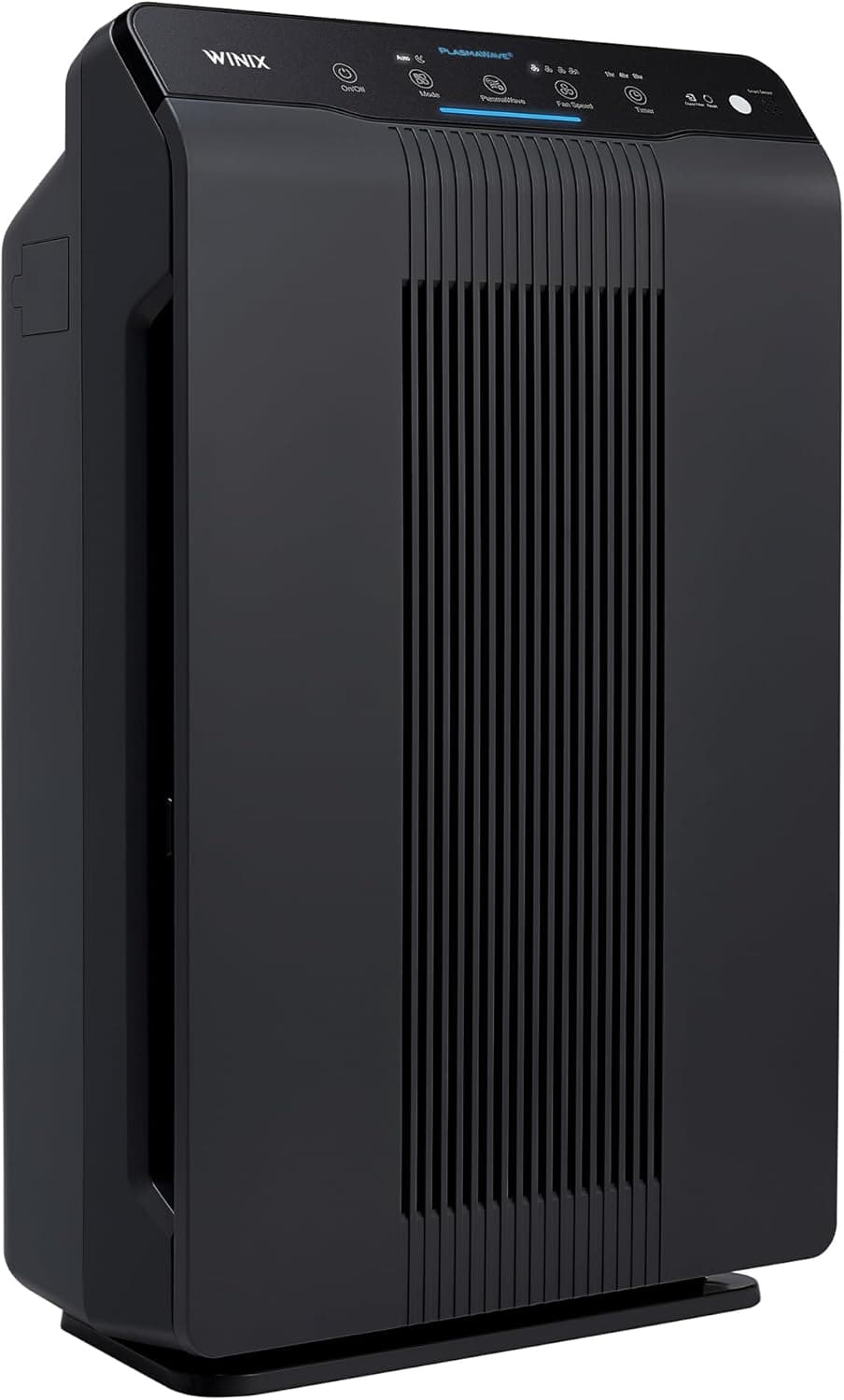
Winix 5500-2 Air Purifier with True HEPA, PlasmaWave and Washable AOC Carbon Filter
Best pick for homes with odors alongside particles. Washable AOC carbon filter keeps ongoing costs down, True HEPA captures 99.97% of particles, PlasmaWave neutralizes chemical vapors. Auto mode responds to both particle and odor sensors. Covers 360 square feet. Annual filter cost around $50 for the HEPA component, with the carbon filter being washable and lasting years.
Levoit Core 400S-P
If you have a large open living area, a great room, or a main floor that is all one connected space, the Core 400S-P is where I would go. It has the highest CADR of any unit on this list at 260 CFM for dust, and it covers up to 400 square feet at five air changes per hour, or nearly 1,200 square feet at two air changes per hour for larger spaces with lower filtration intensity needs.
The smart WiFi connectivity is what separates this from the Core 300-P. Through the VeSync app, you can monitor air quality readings in real time, set schedules, check filter life, and control fan speed from anywhere. I use it to ramp up the unit an hour before the boys start their school day in the morning, so the main living area is already running clean when we settle in. The auto mode uses a built-in PM2.5 sensor and VOC sensor to adjust fan speed without me having to think about it.
Sleep mode on the 400S-P is genuinely quiet at 24 dB, which is the same as the smaller Core 300-P. The display dims automatically in sleep mode. Battery life is not a concern since it is corded, but the energy use is worth noting: at max speed it draws 45 watts, but in sleep or auto mode at a steady state it uses much less.
The filter replacement for the Core 400S-P runs about $35 to $45 per year and is straightforward to change. Levoit sells genuine replacement filters on Amazon and the quality is consistent.
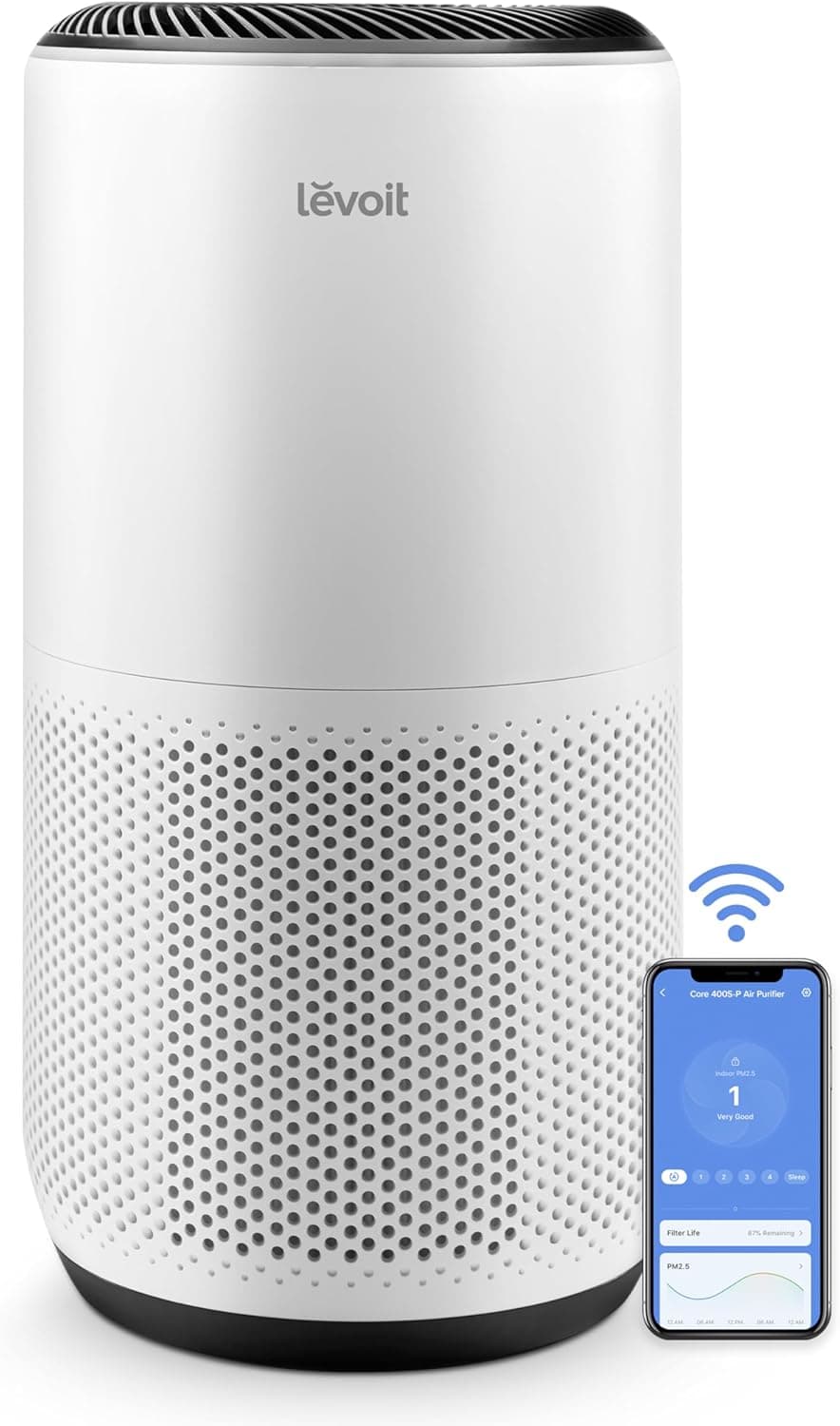
LEVOIT Core 400S-P Air Purifier for Large Rooms, HEPA Sleep Mode, Smart WiFi, Auto Mode
The large-room pick with app control. 260 CFM CADR, covers up to 400 square feet at five air changes per hour. Smart WiFi via VeSync app for scheduling, remote control, and real-time air quality monitoring. PM2.5 and VOC sensors in auto mode. 24 dB sleep mode. Annual filter around $35 to $45. Best for open living areas or anyone who wants to set and forget via an app.
How Many Units Do You Actually Need
This is the question I get asked most often, and the honest answer is: at least two if you have kids at home all day and anyone in the house has seasonal allergies.
A single unit in the bedroom handles the most critical space, since that is where you are spending seven to nine hours in a contained area. If the bedroom is the only room you treat, you will likely notice the biggest single improvement in how rested and clear-headed you feel.
From there, a second unit in whatever shared space gets the most use, whether that is the living room, a playroom, or a school area, covers the hours when everyone is awake and active. In our house, the Levoit Core 400S-P runs in our main living area during school hours and the Core 300-P runs in my bedroom overnight.
You do not need a unit in every room. Placement in the spaces where you spend concentrated time matters more than total coverage square footage.
One Thing That Surprised Me
I assumed that cooking was not a significant indoor air quality issue. I was wrong. On days when I do a lot of stovetop cooking, especially anything with high heat or browning, the Coway in our main room registers a spike every time. It handles it quickly, usually cleaning back to baseline within 10 to 15 minutes, but the frequency of those spikes surprised me. Running the range hood is the first line of defense, but having a unit in the room that responds automatically makes a real difference.
The other surprise was how much the air quality improved simply from vacuuming. Running the vacuum kicks particles into the air that the purifier then has to clean up. Running the purifier before, during, and after vacuuming is now just part of my routine on cleaning days.