Best Embroidery Kits for Beginners to Build Real Skills
Embroidery kits Eve tested as a complete beginner, from a progressive stitch guide to a floral pattern set, and exactly what to look for before buying.
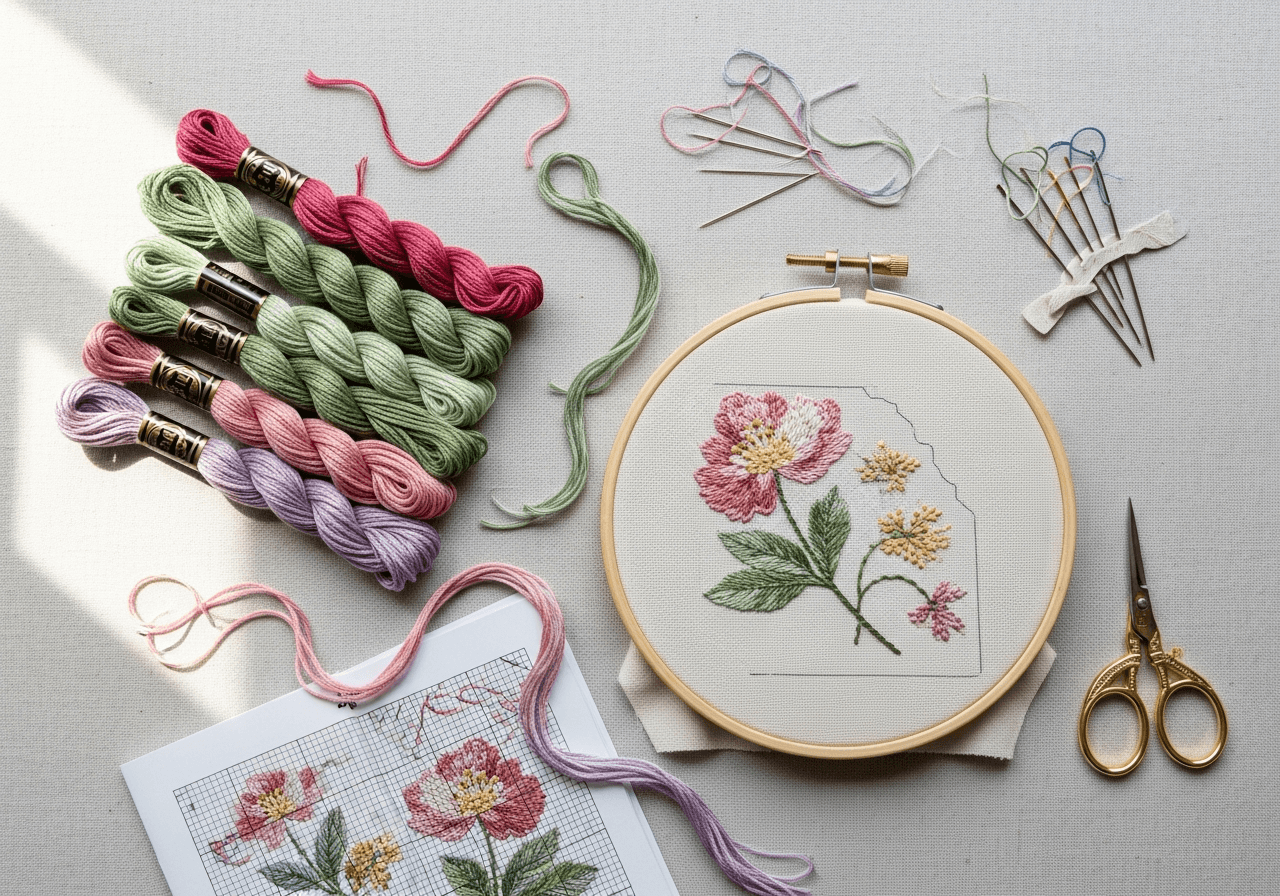
Embroidery was one of those crafts I told myself I would pick up "someday" for about three years. I kept seeing gorgeous finished pieces on Instagram, those lush floral hoops with perfect satin stitches, and thinking it looked both beautiful and completely beyond what I could do with my hands. I am not naturally crafty. My first candle attempt made my kitchen smell like a gas station for two days. I was skeptical.
What finally got me started was a rainy Saturday in February with nothing on the calendar and a beginner kit on my doorstep that I had impulse-ordered. The experience was genuinely mixed: some things about that first kit were helpful, but I ended up switching to a different one about three weeks in, and understanding a lot more once I had compared the two side by side.
The four kits I am recommending here are the ones I ended up trusting after testing, plus two I have since bought for my twelve-year-old niece, who is now significantly better at this than I am. Here is what I actually think about each one, and more importantly, how to choose the right starting point depending on how you learn.
Why Kit Quality Matters More Than You Think
Most beginners assume any embroidery kit will do. It is just a hoop and some thread, right? I thought the same thing before I spent forty-five minutes trying to figure out what a split stitch actually looked like based on a single diagram on a folded instruction card.
The difference between a good beginner kit and a mediocre one comes down to three things: instruction quality, thread organization, and whether the fabric is pre-marked with a pattern you can actually follow. Those three elements determine whether a beginner spends their first hour making something satisfying or unraveling the same section four times out of frustration.
Embroidery has a short but steep learning curve right at the beginning, and then it becomes genuinely relaxing and meditative once you know what you are doing. A good kit gets you over that initial bump. A mediocre one leaves you stuck on the wrong side of it, convinced the craft is harder than it actually is.
What to Look For Before You Buy
Pre-printed or stamped patterns. A kit that comes with fabric that already has the design printed or stamped in washable ink is the single most beginner-friendly feature available. You do not have to trace, transfer, or guess where your needle should go. You follow the lines. This sounds minor until you are sitting there trying to hold a traced pattern in place while threading a needle at the same time.
Thread organization. A kit that gives you loose, tangled skeins is a frustration waiting to happen. Look for kits where floss is wound on bobbins or sorted into labeled bags. Embroidery floss becomes a tangled nightmare if it is not stored properly, and starting with organized thread saves real time in every session.
Video tutorials. Stitch diagrams are useful once you know what you are looking at. For absolute beginners, a QR code or link to actual video tutorials showing hands performing each stitch is worth more than any illustrated guide. You can pause, rewind, and watch the motion in a way that a static image simply cannot show.
A quality hoop. The cheapest hoops crack or lose tension, which makes your work look sloppy and makes it harder to maintain even pressure in your stitches. A bamboo hoop with decent tension hardware is what you want, and most of the kits below include one.
Craftwiz 4-Piece Starter Embroidery Kit
This is the kit I wish I had started with. It comes with four pre-printed 12x12 inch cotton cloths, each designed to teach a specific group of stitches in a logical progression from simple to more complex. A 7.8 inch bamboo hoop, thread in a solid range of colors, needles, scissors, a seam ripper, and a needle threader are all included.
What sets Craftwiz apart from every other beginner kit I have seen at this price is the book. It ships with a physical "Complete Beginner's Guide to Embroidery" that covers not just how to do each stitch but why you would choose it, what designs it suits, and what the most common mistakes look like. I have not found another kit that includes an actual book rather than a folded card. For someone who learns by reading and doing, this makes a real difference.
The video tutorials linked from the kit are well-shot and clear. You can see exactly how thread should lie when a stitch is correctly executed, which helps you self-correct without guessing.
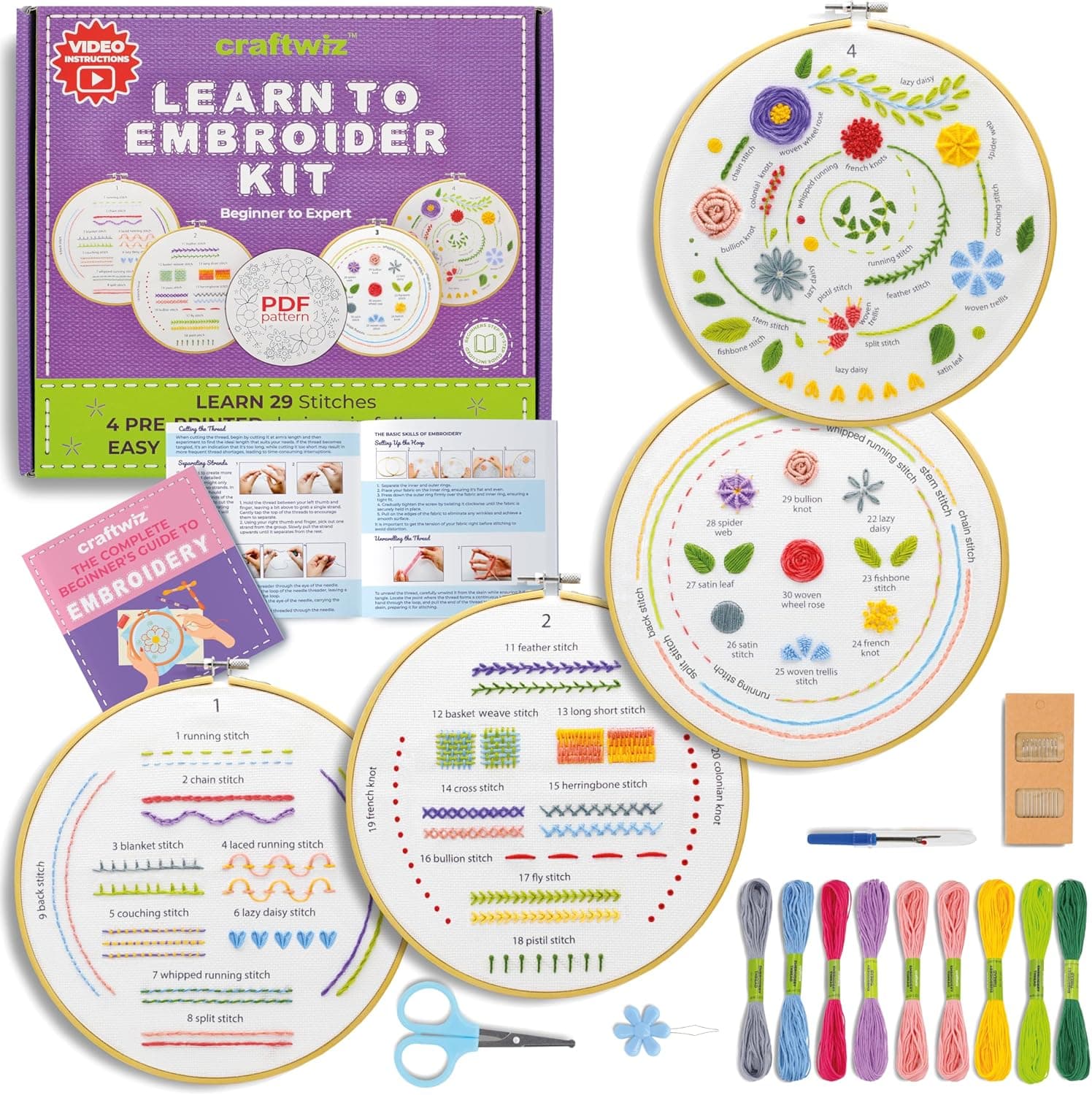
Craftwiz 4-Piece Starter Embroidery Kit for Beginners
Four pre-printed cloths, a bamboo hoop, all tools, and a physical beginner's guidebook covering 29 stitches with video tutorials. The most instructional kit on this list. Best for someone who wants to genuinely learn the craft rather than just complete a single decorative project.
Moni Crafts Embroidery Kit for Beginners
This kit sat open on my kitchen table for most of March. The Moni Crafts embroidery kit was the one that made the learning curve feel manageable for the first time. It includes four stamped floral and botanical patterns on fabric you can see clearly, a bamboo hoop, twelve standard embroidery threads plus five metallic threads, both self-threading and standard needles, and a twenty-four page illustrated guidebook covering 33 stitches.
The stamped patterns are well-designed and the scale is right. Not so tiny that the stitches become finicky, and not so large that you are filling in huge areas without learning much technique. What I found particularly useful is how the four patterns build on each other. You start with simpler designs and work toward more involved ones, so by the fourth pattern you are using four or five different stitch types without it feeling overwhelming.
The metallic thread is a genuinely nice touch that most beginner kits skip entirely. It adds a subtle shine to flower centers and leaf edges that makes finished pieces look significantly more polished than what the basic thread alone would produce.
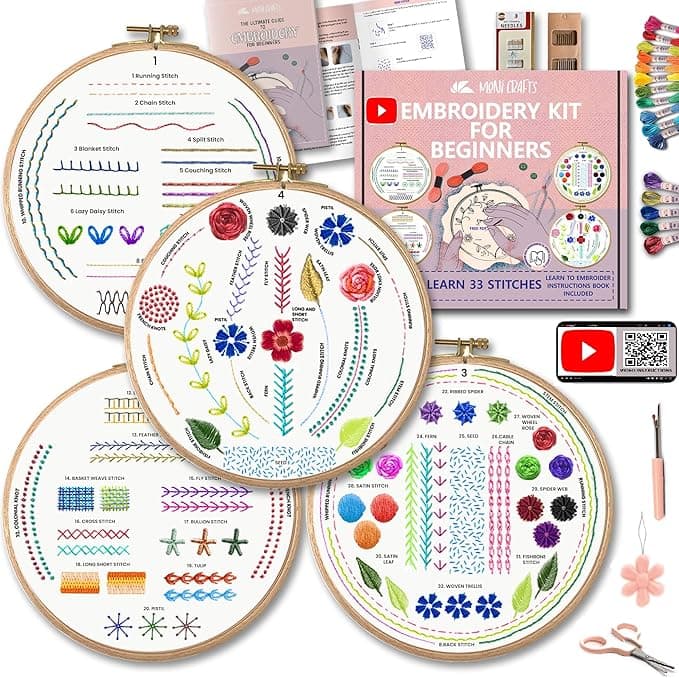
Moni Crafts Embroidery Kit for Beginners
Four stamped botanical patterns, bamboo hoop, twelve threads plus five metallic, and a twenty-four page illustrated guide covering 33 stitches. The most visually appealing patterns on this list. A strong choice if the look of the finished piece matters as much as the learning process.
Bradove Classic Embroidery Stitches Practice Kit
If the Craftwiz and Moni Crafts kits are about completing projects while you learn, the Bradove Classic Embroidery Stitches Practice Kit is about building technique without the pressure of finishing anything in particular. It is structured around muscle memory for individual stitches rather than working through a finished design.
This is my favorite recommendation for anyone who feels anxious about ruining a beautiful pattern. With the Bradove kit, the whole point is practice. You learn how to separate embroidery floss (which sounds obvious until you watch someone struggle with it for ten minutes), how to start and end stitches without knots showing on the back, and how to execute each stitch correctly before moving on. The fabric comes pre-marked with practice areas for each stitch type, so you always know exactly where to work.
The videos that accompany this kit are more technique-focused than the others here. That specificity is exactly what makes it useful for building a real foundation rather than just getting through a single project. I gave one of these to my niece before any of the project-based kits, and I think it made a visible difference in how quickly she progressed. She understood why each stitch works a certain way rather than just mimicking the motion without context.
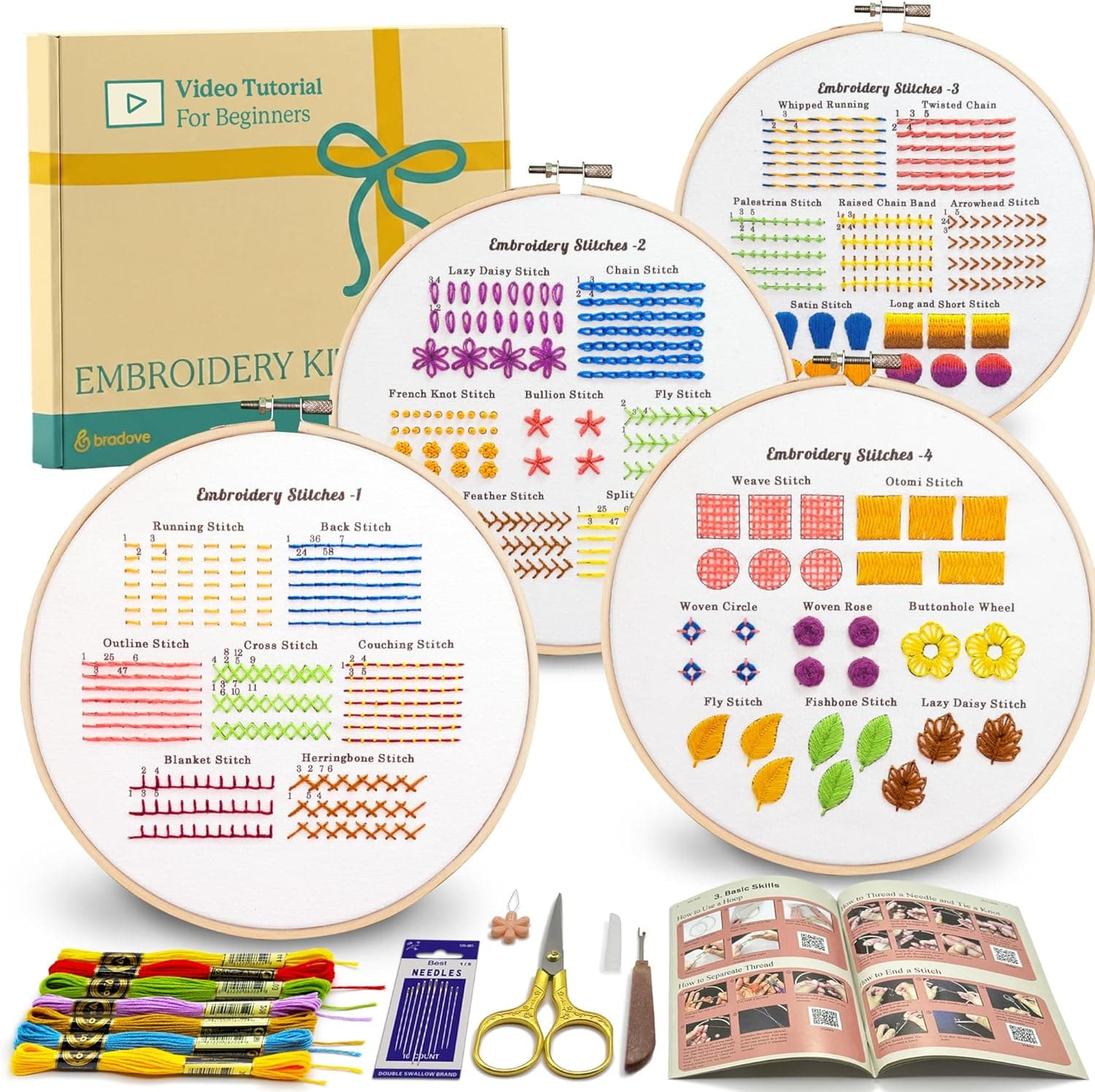
Bradove Classic Embroidery Stitches Practice Kit
A stitch-technique practice kit that teaches the actual fundamentals: how to separate floss, tie knots properly, and execute core stitches with correct form. Pre-marked practice fabric and focused video tutorials. Best for beginners who want a solid foundation before moving to project-based kits.
CYANFOUR Embroidery Kit for Beginners (4-Stage)
The CYANFOUR kit is the most structured learning experience on this list. It is designed as a four-stage progressive curriculum that moves you from basic stitches in stage one through increasingly complex techniques by stage four, with each stage building on what came before.
If you are someone who gets frustrated without a clear roadmap, this is the kit for you. The stages are clearly labeled, the instructions explain not just how to do each stitch but when to use it and what visual effect it creates, and the videos are well-produced. By the end, you will have covered 38 distinct stitches in an order that actually makes sense.
Where this kit falls slightly short is in visual variety. The designs are functional but not as beautiful as the Moni Crafts patterns. The trade-off is a genuinely comprehensive stitch education, more techniques in a more logical sequence than any other kit here. I would recommend this one for the methodical learner who wants to finish feeling like they completed a course, not just made a few nice things.
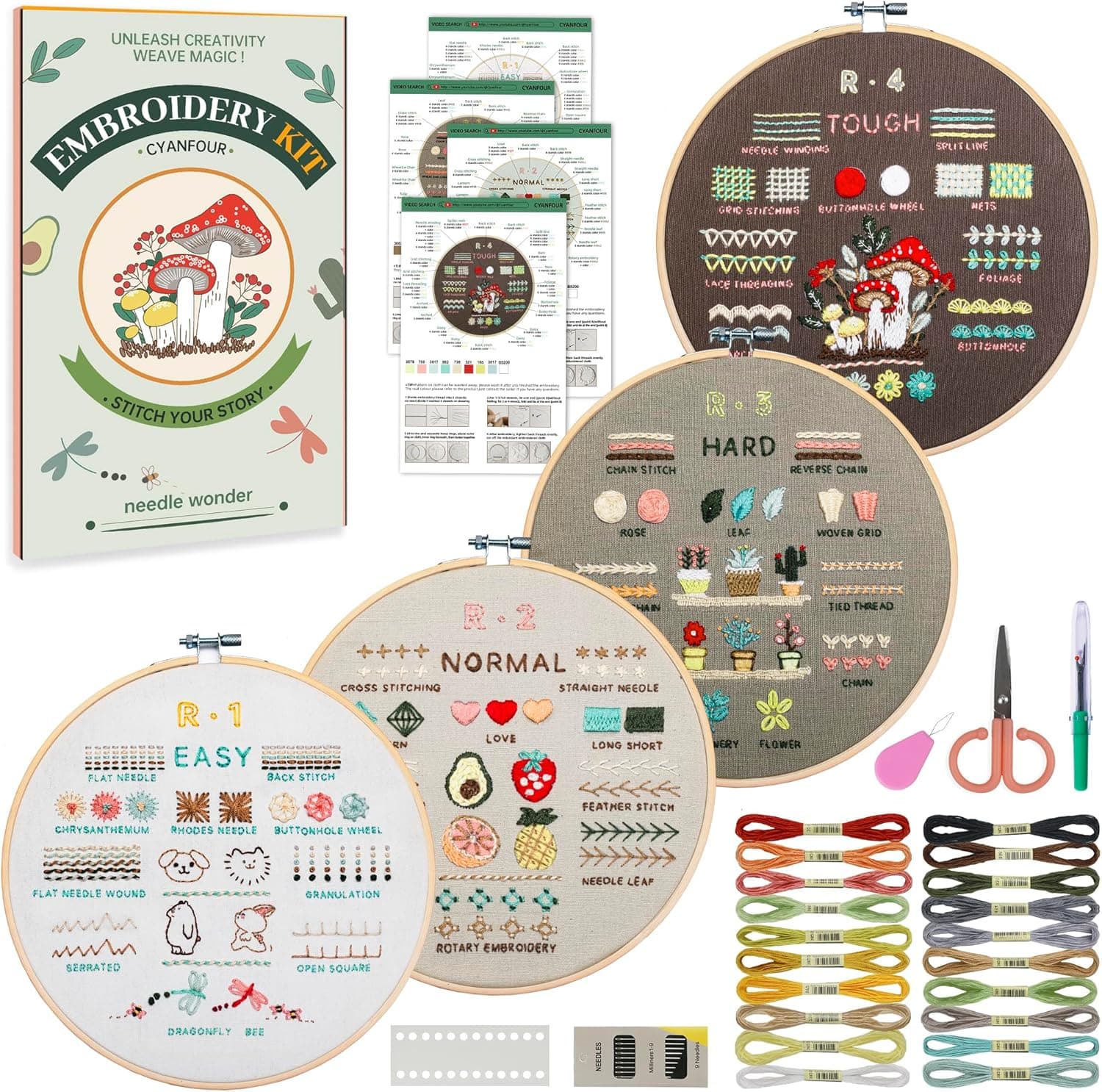
CYANFOUR Embroidery Kit for Beginners, 4 Stages to Learn 38 Stitches
A four-stage progressive curriculum covering 38 stitches with step-by-step instructions and clear video tutorials. The most structured learning path on this list. Best for beginners who want to leave the kit with a comprehensive stitch vocabulary rather than just a finished decorative piece.
Which Kit Should You Actually Buy?
Here is the honest breakdown. If you want one recommendation and nothing more: start with the Craftwiz kit. It has the most complete instructional materials, the physical book is genuinely useful, and the four pre-printed cloths give you enough variety to cover real skill progression without overwhelming you.
If the visual appeal of the finished piece matters most to you, and you want something beautiful enough to frame on a wall when you are done, go with the Moni Crafts kit. The patterns are the most aesthetically pleasing option here, and the metallic thread adds something the others do not have.
If you are the type who gets anxious about ruining a nice design before you feel ready, get the Bradove practice kit first. Spend two weeks on it, then move to one of the project-based options. You will feel noticeably more confident walking into your first real pattern.
And if you want the most thorough stitch education possible, the CYANFOUR four-stage kit will teach you more techniques than anything else on this list, delivered in a sequence that genuinely builds on itself.
The honest caveat across all four: none of them will make your finished piece look like the photos immediately. Early stitches will be uneven, and that is completely normal. The kits worth buying are the ones that get you past that stage quickly with good instruction and solid materials.
A Few Things I Wish Someone Had Told Me First
Slow down more than feels necessary. The biggest beginner mistake is pulling thread too tight or rushing through sections. Even tension only comes from deliberate slowing down while you are learning, and it becomes second nature faster than you expect once you prioritize it.
Work in good light. I ruined an entire section of a project under dim overhead lighting because I could not see the stamped pattern lines clearly. Natural light or a bright task lamp makes a meaningful difference in accuracy, and your eyes will thank you after an hour of close work.
Keep the back neat from the start. You will be tempted to take shortcuts on the back of the work since nobody sees it. Resist this. The habits you build about starting and ending threads cleanly become automatic quickly, and a neat back is what makes the front look professional.
Frame your first piece, even if it is imperfect. My first finished embroidery was not particularly good by any objective measure. I framed it anyway, and it still hangs in my craft room. Seeing a finished piece on a wall is more motivating than anything else I found for actually continuing the practice.