Homemade Candle Making: A Beginner's Guide from Scratch
Learn how to make candles at home, wax types, wicks, scents, molds, safety tips, and creative gift ideas. A complete beginner's guide to DIY candle making.

I started making candles the same way I start most of my projects, by being annoyed at how expensive the good ones are. Twenty-five dollars for a single candle that burns for forty hours? When the ingredients cost a fraction of that? No thank you.
So I bought a candle making kit, made a mess in my kitchen, and ended up with six slightly imperfect but wonderful-smelling candles that cost me less than that one store-bought jar. I was hooked.
Candle making is genuinely one of the most satisfying crafts you can pick up. It's part science, part art, and the results are immediately useful and giftable. Plus, once you start making your own, you realize how simple the ingredients are, and how much you've been overpaying for what amounts to wax, a wick, and some fragrance.
If you've been curious about trying it, here's everything you need to know to get started.
Choosing Your Wax
The wax you choose affects how your candle burns, how it holds scent, and how it looks. Here are the main options:
Soy wax is my top recommendation for beginners. It's natural, burns cleanly, holds scent well, and is very forgiving to work with. It has a lower melting point than other waxes, so it's easier to handle. The finish is creamy and smooth, though sometimes you'll get frosting on the surface, that's normal and doesn't affect performance.
Beeswax is beautiful and has a natural honey scent. It burns longer than most other waxes and purifies the air as it burns. It's more expensive and can be tricky with fragrance oils (it has its own strong scent that competes), but pure beeswax candles are lovely on their own. If you're into homesteading and keep bees, this is the ultimate use for your wax.
Coconut wax blends are becoming popular because they throw scent beautifully and have a luxurious, creamy appearance. They're usually blended with soy or other waxes for structure.
Paraffin wax is what most commercial candles use. It's inexpensive and throws scent strongly, but it's petroleum-based, which is a dealbreaker for some people. It does produce more soot than natural waxes.
My recommendation: Start with soy wax flakes. They're affordable, easy to melt, and produce beautiful results even on your first try.
Wicks, Containers, and Scents
Wicks. The size of your wick needs to match the diameter of your container. Too small and the candle tunnels (only melts in the center). Too large and it burns too hot and fast. Most candle supply kits include a wick guide, but as a general rule: for a standard 8-ounce jar, a medium cotton wick works well. Pre-tabbed wicks (already attached to a small metal base) are easiest for beginners.
Containers. You can use mason jars, vintage teacups, ceramic bowls, tin cans, almost anything heat-safe. Avoid anything that might crack with heat, like thin glass or plastic. I love using thrifted teacups and small ceramic dishes for gift candles.
Fragrance oils vs. essential oils. Fragrance oils are specifically formulated for candle making and generally throw scent better. Essential oils work too, but you'll need to use more and some scents don't hold up well to heat. For beginners, fragrance oils give you more reliable and stronger results.
A rule of thumb for scent: Use about 1 ounce of fragrance oil per pound of wax. This gives a nice scent throw without being overwhelming.
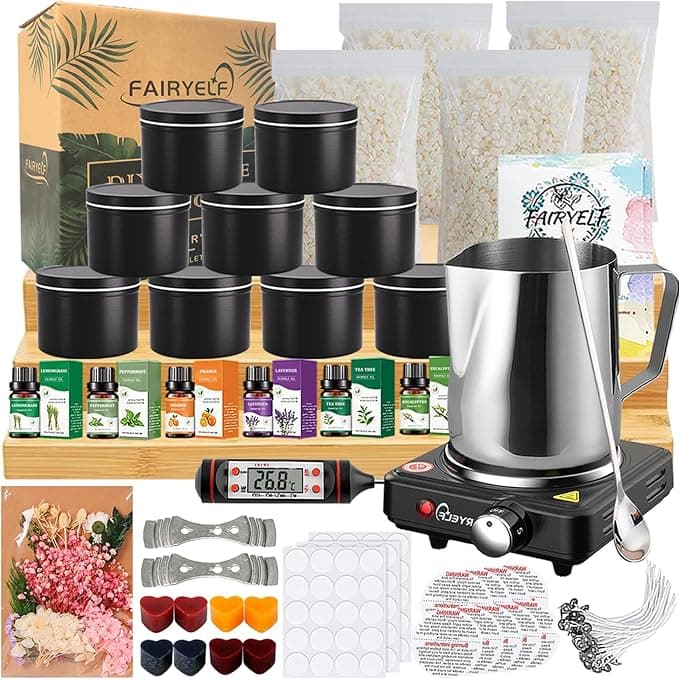
FAIRYELF Candle Making Kit for Adults with Soy Wax & Wax Melter
Complete candle-making supplies, soy wax, wicks, fragrance oils, dye blocks, a wax melter, thermometer, pouring pot, and tins, all in one starter kit.
Step-by-Step: Making Your First Candle
Here's the basic process. Once you've done it once, it becomes second nature.
1. Prepare your containers. Place a wick in the center of each container. Use a dab of hot glue or a wick sticker to secure the base. Lay a pencil or chopstick across the top and wrap the wick around it to keep it centered.
2. Melt the wax. Use a double boiler (or a pouring pot inside a regular pot of water). Heat the wax slowly to the temperature recommended on the package, usually around 170-180 degrees F for soy wax. Use a thermometer. Don't overheat.
3. Add fragrance. Remove the wax from heat and let it cool slightly to the temperature recommended for adding fragrance (usually around 135-145 degrees F for soy). Stir in your fragrance oil slowly and thoroughly for about two minutes.
4. Add color (optional). If you want colored candles, add candle-specific dye at the same time as the fragrance. Liquid candle dyes are easiest to control, start with a few drops and add more until you like the shade. Remember that the color will lighten significantly as the wax cools and hardens, so go a shade or two darker than your target.
5. Pour. Pour the wax slowly into your prepared containers. Leave about half an inch of space at the top. Pour at around 130-140 degrees F for the smoothest finish.
6. Let it cure. This is the hard part, waiting. Let your candles sit undisturbed for at least 24 hours. For the best scent throw, let soy candles cure for a full week before burning. I know, it's painful. But it's worth it.
7. Trim the wick. Before your first burn, trim the wick to about 1/4 inch. This gives you a cleaner, steadier flame and less soot.
Safety Tips
Candle making involves hot wax and an open heat source, so respect the process:
- Never leave melting wax unattended. It can overheat and catch fire.
- Keep a fire extinguisher nearby. Never use water on a wax fire, it splatters.
- Work on a protected surface. Wax spills happen and they're annoying to clean up. Lay down newspaper or parchment paper.
- Keep kids and pets away while you're melting and pouring. Let them help with decorating and labeling once the candles are cool.
- Use a thermometer every time. Guessing temperatures leads to poor results or safety issues.
- Wipe up wax spills while they're still warm, cooled wax is much harder to remove. For wax on fabric, place a paper bag over the spot and iron on low to absorb it.
- Work in a well-ventilated area, especially when using fragrance oils. Open a window or turn on a fan.
Creative Gift Ideas
Homemade candles make incredible gifts, and this is honestly what turned candle making from a hobby into something I do year-round.
Holiday gift sets. Pour candles in small tins or jars, choose seasonal scents (cinnamon, pine, vanilla for winter; lavender, citrus, fresh linen for summer), and package them in a simple box with tissue paper.
Custom scent blends. Make candles in people's favorite scents. My sister gets vanilla and sandalwood every year. My mom gets lavender and eucalyptus. It becomes something they look forward to.
Themed gift baskets. Pair a homemade candle with a mug, a bag of good coffee or tea, and a cozy pair of socks. Add some homemade cleaning products for a full self-care basket.
Wedding or shower favors. Small tin candles with a custom label are a thoughtful favor that people actually want to take home.
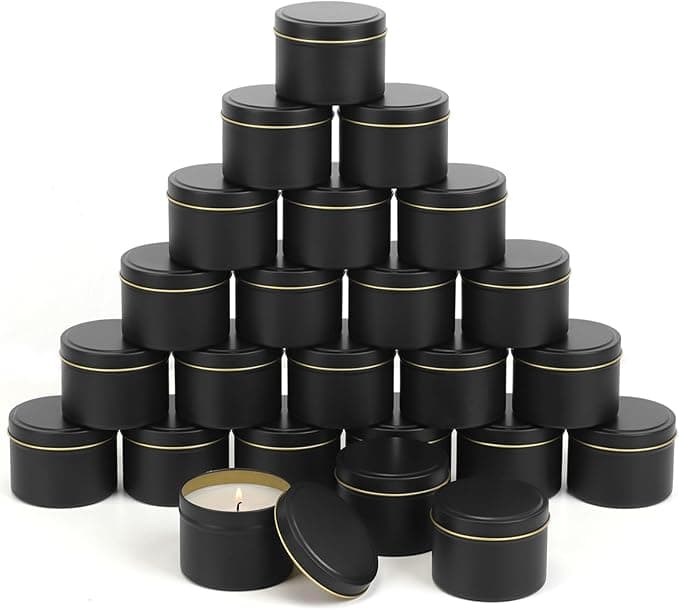
SONVIIBOX 24-Pack 4oz Black Candle Tins with Lids
Seamless metal tins with fitted lids, perfect for gift candles, travel candles, and testing new scent combinations in small batches.
Troubleshooting Common Issues
Tunneling (wax only melts around the wick): Your wick is too small for the container. On your next batch, size up. For the current candle, you can try wrapping aluminum foil around the top to reflect heat and melt the edges.
Wet spots (air pockets between wax and glass): Purely cosmetic. They happen when the wax cools unevenly and pulls away from the container. Preheating your jars slightly before pouring can help reduce them.
Frosting (white crystalline coating on soy candles): This is natural and doesn't affect burn quality. It's actually a sign of pure soy wax. Embrace it.
Weak scent throw: Either not enough fragrance oil, the wax was too hot when you added it (which burns off the scent), or the candle hasn't cured long enough. Let it sit for a full week and try again.
Cracking or sinkholes on top: This happens when the wax cools too quickly or unevenly. Save a small amount of melted wax when you pour and use it to fill in any sinkholes once the candle has cooled. Pouring at a slightly lower temperature also helps.
Seasonal Scent Ideas
Part of the fun is changing your scent palette with the seasons. Here are some combinations I come back to year after year:
Spring: Lemon verbena + basil, fresh cut grass + cucumber, peony + white tea. Light and bright scents that make the house feel open and airy.
Summer: Coconut + lime, watermelon + mint, sea salt + driftwood. Anything that feels breezy and relaxed.
Fall: Apple cider + cinnamon, pumpkin + vanilla, amber + sandalwood. These are the scents that make people walk into your house and immediately feel cozy. They pair beautifully with seasonal wreaths on the front door.
Winter: Balsam fir + cedar, cranberry + orange, vanilla + clove. Warm and nostalgic without being overwhelming.
Write down your favorite combinations and ratios as you experiment, it's easy to forget what you did when a candle turns out perfectly and you want to recreate it.
Once you get the basics down, candle making becomes one of those relaxing evening activities that also happens to produce things everyone wants. Start simple, experiment with scents, and enjoy the process. Your house will smell incredible in the meantime.