Best Pressure Canners for Home Canning: A Practical Guide
The best pressure canners for home canning, from a beginner-friendly digital model to the All American that lasts a lifetime. Honest picks from someone who tested them.
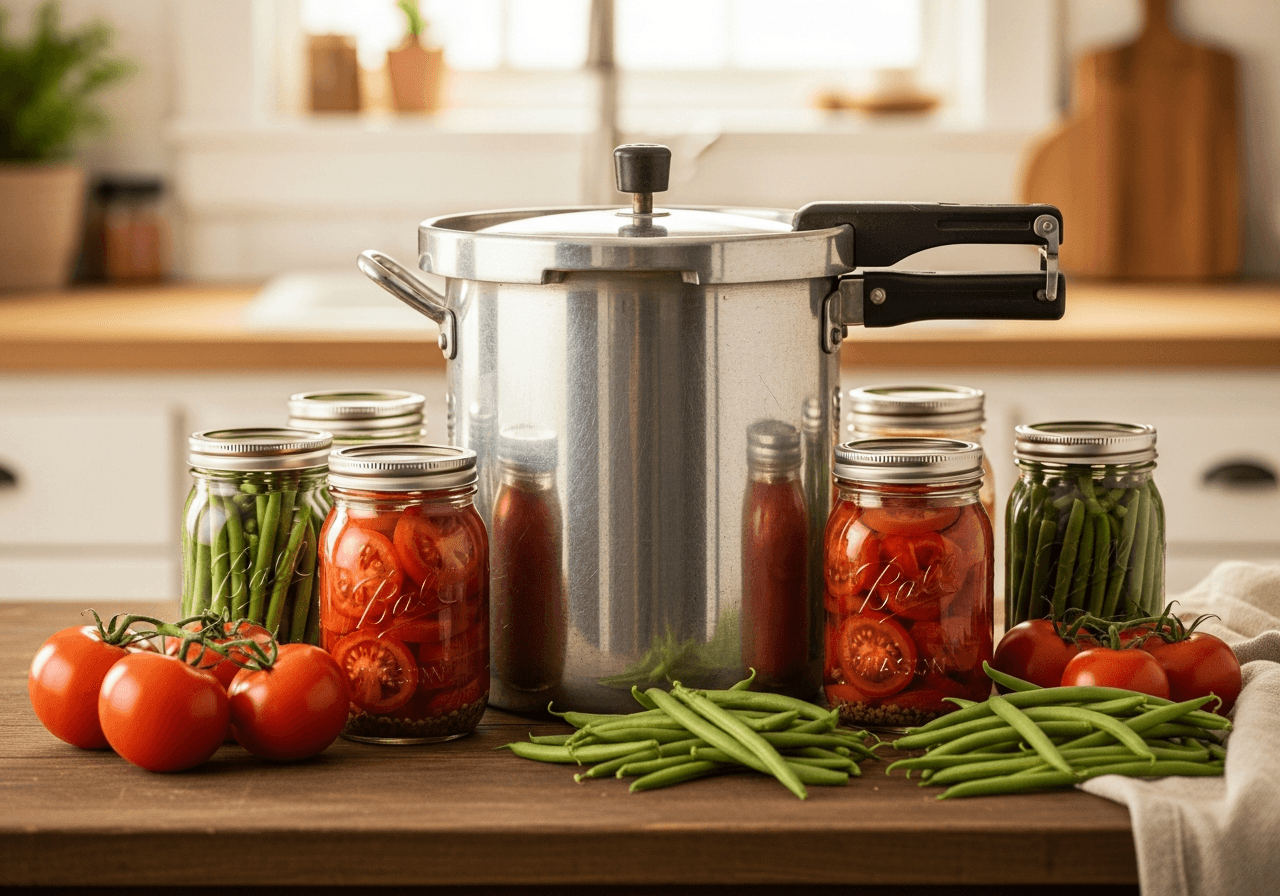
The first time I pressure canned anything, it was green beans from my garden. I had read the instructions three times, watched two different YouTube videos, and still stood at my stove for twenty minutes holding the jar rack over the pot, absolutely convinced something was about to go wrong.
Nothing went wrong. The beans came out perfectly, and I stood in my kitchen staring at seven gleaming jars like I had just performed a minor miracle.
The truth is, pressure canning is less intimidating than it looks once you understand what you are doing and have good equipment under you. The canner is the single most important decision you will make, because it determines whether the whole process feels manageable or chaotic. I have used three different canners over the past few years, and I can tell you with confidence that they are not all equal in terms of ease, reliability, or longevity.
This post covers the three I recommend, from the most beginner-friendly option to the workhorse that homesteaders pass down like heirlooms. I will also share what I learned the hard way so you can skip the parts that frustrated me.
Why You Cannot Skip the Pressure Canner
A lot of people ask me whether they can use a regular pressure cooker or an Instant Pot for pressure canning low-acid foods. The honest answer is no. The USDA does not recommend standard electric pressure cookers for pressure canning because they cannot be verified to reach and hold the temperature required to make low-acid foods safe. If you want to can vegetables, meats, soups, or beans, you need a dedicated pressure canner.
Water bath canning is different and works beautifully for high-acid foods like jams, jellies, pickles, and tomatoes with added lemon juice or citric acid. But for anything low-acid, including green beans, corn, potatoes, carrots, and all meats, pressure canning is the only method the USDA considers safe for eliminating botulism risk.
This is not me being overly cautious. Botulism is odorless and tasteless, which means you cannot detect it by looking at or smelling a jar. The right canner and the right processing time are what keep your family safe.
What I Look for in a Pressure Canner
Before I get into specific products, here is what matters when you are choosing:
Capacity. Most families do best with a canner that holds at least 7 quart jars or 16 to 20 pints at once. Canning in small batches is frustrating when you have a full harvest to process. Larger capacity means fewer batches and less time standing at the stove.
Gauge type. Stovetop canners use either a dial gauge (which shows you the exact pressure reading) or a weighted gauge (which regulates pressure automatically and rocks to let you know it is at the right level). Dial gauges need to be tested for accuracy once a year through your local cooperative extension office. Weighted gauges do not.
Gasket or no gasket. Most aluminum canners use a rubber gasket to create a seal between the lid and the pot. Gaskets need to be replaced every couple of years. The premium exception is the All American line, which uses a metal-to-metal seal with no gasket at all.
Stove compatibility. If you have a glass or flat-top stove, check before you buy. Some large canners are not recommended for use on smooth-top ranges because of their weight. I learned this the expensive way.
Presto 02152 17-Quart Digital Pressure Canner
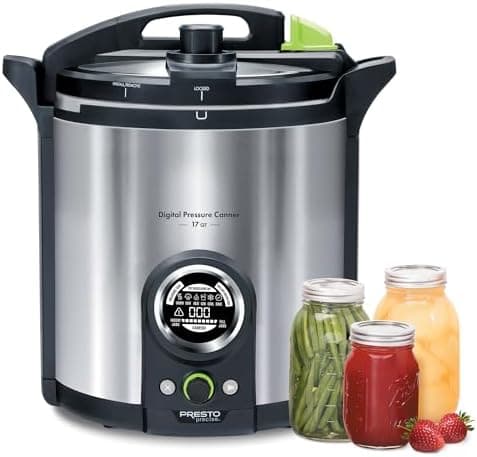
If I were starting over from scratch, I would begin with the 17-quart digital pressure canner from Presto. It is the first electric pressure canner that meets USDA home canning guidelines for safely processing low-acid foods, and the digital design removes almost all of the guesswork that trips beginners up.
The way it works is different from a stovetop canner. Instead of managing heat and pressure by adjusting your burner and watching a gauge, the Presto 02152 has a built-in temperature sensor that automatically regulates the processing temperature to the exact level required for safe canning. It also handles altitude adjustments automatically, which is a significant deal if you live above 1,000 feet and have ever had to try to figure out which processing time adjustments apply to you.
It comes with a digital display and a built-in timer. When your processing time is done, the canner alerts you. You do not have to watch a clock or stand next to the stove. I have canned a batch of chicken broth, started a batch of green beans, and gotten dinner on the table all in the same afternoon without feeling frantic, which was not something I could say when I was babysitting a stovetop canner.
The 17-quart size holds 4 quart jars, 5 pint jars, or 8 half-pint jars at a time. It is smaller than my stovetop options, which means I do sometimes need to run two batches for a big harvest. But for a first canner, the trade-off in ease of use is worth it.
One honest caveat: the Presto 02152 is an electric appliance, which means it is a dedicated counter appliance rather than something you tuck into a cabinet. If counter space is at a premium in your kitchen, that is worth thinking through before you buy.
Presto 02152 17-Quart Digital Pressure Canner
The first electric pressure canner to meet USDA guidelines for safely processing low-acid foods. Built-in temperature sensor holds the exact processing temperature without manual adjustments, and handles altitude automatically. Digital display and built-in timer mean you do not have to watch the stove. Holds 4 quart jars, 5 pint jars, or 8 half-pint jars. Also doubles as a water bath canner for high-acid foods. Stainless steel exterior.
All American 1930 21.5-Quart Pressure Canner
If the Presto digital is the canner for beginners, the All American 921 is the canner for people who have decided this is a permanent part of their life.
I bought my All American 921 after two years of pressure canning and I have not looked back since. It is made in the USA from heavy-duty cast aluminum, holds 7 quart jars or 19 pint jars per batch, and features the signature metal-to-metal sealing system that sets All American apart from every other canner on the market.
That metal-to-metal seal means no gasket. Ever. No ordering replacement gaskets, no checking whether your gasket is cracked before a big canning day, no gasket blowouts mid-session. The lid is precision-machined to create a steam-tight seal with the pot itself, held in place by eight positive-action clamping bolts that tighten down evenly around the perimeter. It is a satisfying thing to use.
The All American comes with a three-piece pressure regulator that can be set to 5, 10, or 15 PSI, plus a dial gauge so you can always see exactly where your pressure is. Because it has both a weighted regulator and a dial gauge, you get the convenience of automatic pressure regulation with the ability to verify what is happening inside. Most canners give you one or the other.
The weight of this canner is real: empty, the 921 is nearly 18 pounds, and it holds around 21 quarts of liquid plus jars when loaded. It is not something you move around casually. Mine lives on the back burner of my range and stays there for canning season. If you have a smooth-top stove, check the manufacturer's guidance, because large canners can stress glass cooktops, and the All American is a substantial piece of equipment.
The price is significantly higher than the Presto digital, and significantly higher than the T-fal below. But this is one of those things that, if you are going to can seriously, you buy once. Homesteaders have passed these down to their children. That says something.
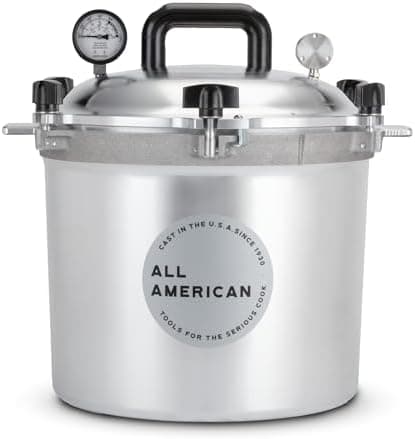
All American 1930 21.5-Quart Pressure Canner (The 921)
The gold standard pressure canner for serious homesteaders. 21.5-quart capacity holds 7 quart jars or 19 pint jars. Exclusive metal-to-metal sealing system means no gasket to replace, ever. Includes both a weighted regulator (5, 10, or 15 PSI) and a dial gauge. Heavy-duty cast aluminum construction, made in the USA. This is the canner you buy once and keep for decades. Heavier than other options and best suited to gas or electric coil ranges.
T-fal 22-Quart Aluminum Pressure Canner
The T-fal 22-Quart is the canner I recommend when someone tells me they want to start pressure canning on a tight budget and they are not yet sure whether they will love it enough to invest in the All American.
It is a classic stovetop canner with a large capacity, a straightforward dial gauge, and a three-position pressure regulator. The 22-quart pot holds 7 quart jars or up to 16 wide-mouth pint jars per batch, which means it can handle a real harvest even though the price is modest.
The construction is polished aluminum, which heats up quickly and evenly. The lid uses a rubber gasket (replacement gaskets are available separately and inexpensive), and the whole thing is lighter than the All American at around 8 pounds empty, which makes it easier to move around and fill at the sink. It is compatible with gas and electric coil ranges, and T-fal notes it should not be used on glass or flat-top stoves.
I used a T-fal canner for my second full canning season and processed dozens of batches of chicken broth, green beans, tomatoes, and venison stew without a single problem. The gauge was accurate when I tested it at the extension office, and it maintained pressure steadily once I got used to managing the burner. My only complaint was that the handles got hot during long canning sessions, so I kept silicone oven mitts nearby.
At roughly a third of the price of the All American, it is a solid entry point. If you start canning and decide it is not for you, you have not overcommitted. If you fall in love with it, you can always upgrade later.
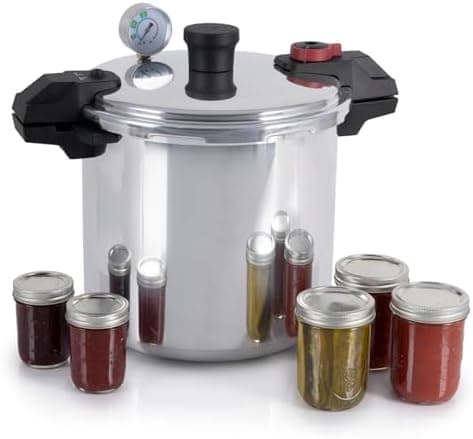
T-fal 22-Quart Aluminum Pressure Canner
A solid, budget-friendly stovetop pressure canner with a large 22-quart capacity. Holds 7 quart jars or up to 16 pint jars per batch. Three-position pressure regulator and dial gauge for accurate pressure monitoring. Polished aluminum construction heats quickly. Lighter and easier to maneuver than the All American. Uses a rubber gasket (replaceable). Best for gas and electric coil ranges. Includes two canning racks and a canning guide.
What to Can First
If you are brand new to pressure canning, start with something simple and something you will actually use. My first recommendation is green beans, called snap beans in some older canning guides. You grow them in the garden, you pick more than you can eat fresh, and the processing instructions are clear and well-tested.
After green beans, chicken broth is a wonderful second project. You make a big batch of broth from a whole chicken, let it cool, skim the fat, and can it in quart jars. Having a shelf full of homemade chicken broth feels genuinely luxurious in January.
From there, most canners move into soups, stews, and meats. You can pressure can pulled pork, venison, black beans, corn, and potatoes, among many other things. The Ball Blue Book of Preserving or the USDA Complete Guide to Home Canning gives tested recipes for everything with processing times and pressure settings.
One thing I want to say clearly: always use a tested recipe for pressure canning. This is not baking where you can improvise a little and see how it turns out. Processing times are calculated based on the density and pH of specific foods, and improvising can result in under-processed jars. The USDA and the National Center for Home Food Preservation have free recipes online. Use them.
What Did Not Work for Me
I bought a cheap pressure canner from a discount store my first year, and the dial gauge was off by 3 PSI when I took it to the extension office. That meant everything I had canned that season was potentially under-processed. I threw out an entire shelf of jars, which was devastating both emotionally and financially.
Since then, I test every dial gauge canner at the beginning of each season. Your local cooperative extension office will test them for free, and it takes about ten minutes. If you have a weighted gauge canner like the All American, you skip this step entirely, which is one of the reasons I eventually switched.
I also went through a phase of trying to can pasta and rice, thinking I could make complete meal-in-a-jar canned goods. Neither works in a home canning setting. The starch absorbs so much liquid during processing that the jars never seal correctly, and the density of thick starches can prevent heat from reaching the center of the jar reliably. Stick to tested recipes and save the pasta for separate pots.
Keeping Your Canning Simple
The canners I have recommended here cover every type of home canner at every price point. The Presto digital is the easiest to start with, the All American is the one you will still be using in twenty years, and the T-fal is the right choice if you want a capable stovetop option without the premium price.
Whichever you choose, pair it with the Ball Blue Book and a reliable source of tested recipes, and you will be canning confidently by the end of your first season.